Amsterdam Airport Map & Terminal Guide 2026
One terminal, three departure halls, seven piers. Everything you need to navigate Amsterdam Airport Schiphol (AMS) — Europe’s second most connected airport and the principal hub for KLM Royal Dutch Airlines.
Amsterdam Airport Map
The Amsterdam Airport map below shows the full layout of Amsterdam Airport Schiphol (AMS/EHAM). Schiphol handled 68.8 million passengers in 2025, a 2.9% rise on the prior year, cementing its place as one of Europe’s major aviation hubs. It is the principal hub for KLM Royal Dutch Airlines and a key node for the SkyTeam alliance, serving 301 destinations across 94 carriers. KLM alone accounts for over 52% of all aircraft movements at the airport.
As you can see on the Amsterdam Airport map, Schiphol uses a single-terminal concept: one large building split into three departure halls feeding seven piers (B, C, D, E, F, G and H/M). Schiphol Plaza, the central public area, sits at the heart of the complex and connects the arrivals level directly to the underground train station. Study the AMS airport map before you travel — and pay particular attention to whether your flight is Schengen or non-Schengen, as this determines which pier you depart from and which passport control corridor you use.
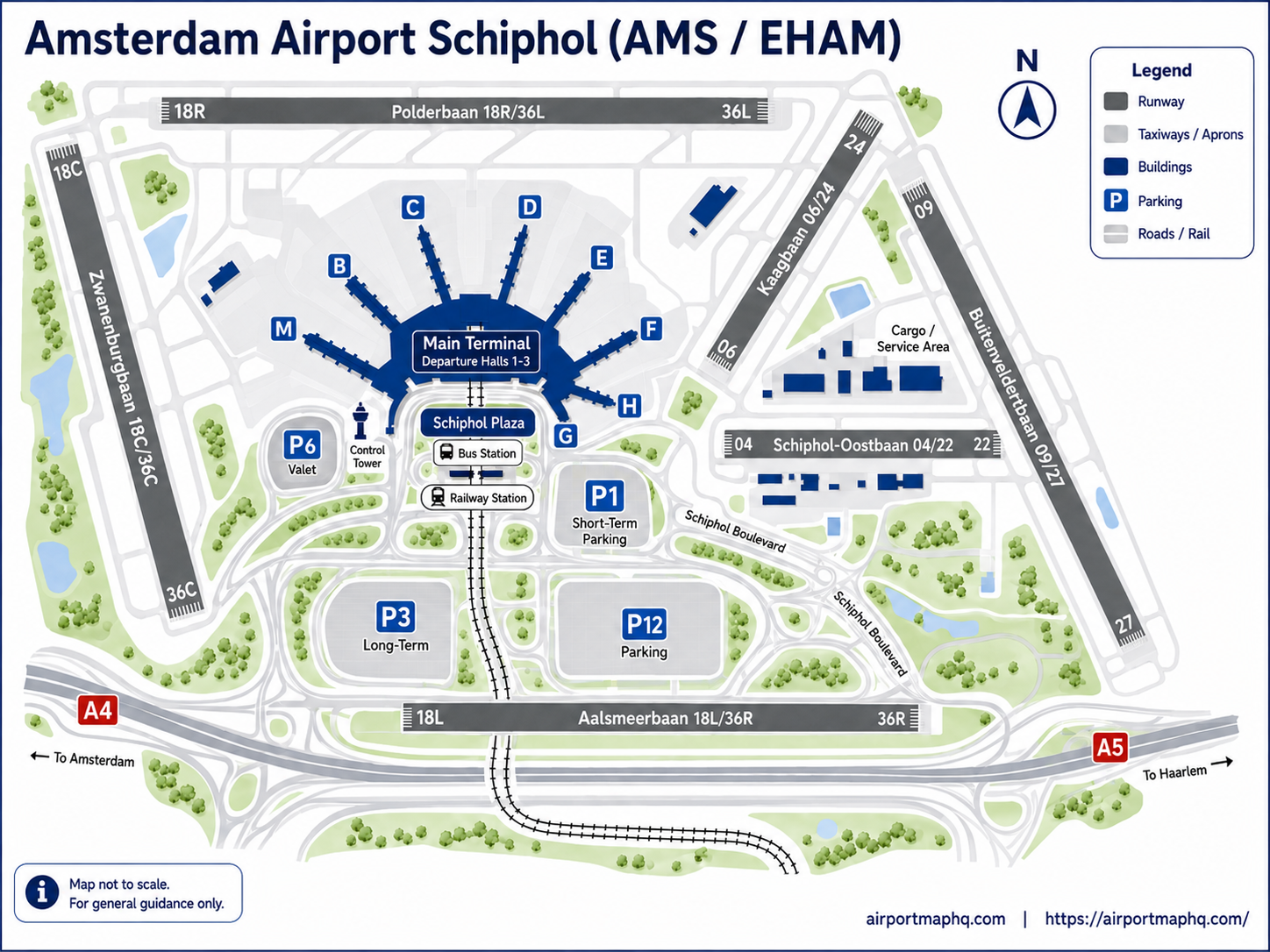 Click image to view full size
Amsterdam Airport Location Map
Amsterdam Airport Schiphol is located 17 km southwest of Amsterdam city centre, in the municipality of Haarlemmermeer in North Holland. The airport sits 4.5 metres below sea level on reclaimed polder land. The Amsterdam Airport location map below shows AMS in relation to the city and the wider region. Access by road is via the A4 motorway from Amsterdam and the A9 ring road from the north and south.
Interactive map showing Amsterdam Airport Schiphol’s location southwest of Amsterdam city centre
View Larger Map
Amsterdam Airport Terminal
Schiphol operates on a single-terminal concept that sets it apart from most large European airports. Rather than separate terminal buildings requiring shuttle buses, everything at Schiphol is contained within one massive complex connected under a single roof. Schiphol Plaza is the central hub of this complex: a large public area on the ground floor housing shops, restaurants, a supermarket, currency exchange and direct access to the underground train station. From Schiphol Plaza, escalators and lifts connect up to the departure level and out to the seven piers.
The terminal is divided into three departure halls, each leading to a set of piers. Departure Hall 1 (east side) serves Piers B and C. Departure Hall 2 (east side) serves Piers D and E. Departure Hall 3 (west side) serves Piers F, G and H/M. Once airside, all halls are interconnected — with the exception of Piers H and M, which are isolated budget piers you cannot exit into the main pier network without leaving security.
Schengen vs. Non-Schengen: The Key to Reading the AMS Map
Amsterdam Airport Security
Security at Schiphol is organised by departure hall. Each hall has its own security checkpoint, so you go through security closest to your pier rather than at one central location. Schiphol has deployed 3D baggage scanners at its checkpoints, which means you do not need to remove liquids or laptops from your bag before screening — a significant time saver. You can book a free 15-minute security time slot online via the Schiphol app or website during busy periods.
Amsterdam Airport Piers
Schiphol’s seven piers (B, C, D, E, F, G and H/M) stretch out from the central terminal in a roughly fan-shaped layout. Walking distances between the furthest piers can reach 15–20 minutes, so the Amsterdam Airport map is worth studying before you arrive. All piers except H and M are accessible from each other airside once you have cleared security in the correct zone.
Pier B & Pier C — Departure Hall 1 (Schengen)
Piers B and C form Departure Hall 1 and are dedicated entirely to Schengen flights. Pier B has 14 gates and Pier C has 21 gates. These piers handle a range of European carriers including KLM’s shorter Schengen routes, along with Lufthansa, SAS, Swiss, Iberia, Brussels Airlines and others. The recently renovated Hall 1 area features wider security lanes, more seating and modern concessions.
Pier C is currently undergoing phased renovation as part of Schiphol’s long-term expansion programme. Expect some temporary hoarding and gate changes through 2026–2027.
Pier D — Departure Hall 2 (Mixed Schengen and Non-Schengen)
Pier D is the largest and most complex pier at Schiphol. It spans two levels and is shared between both departure halls. The lower level (gates D1–D57) handles non-Schengen international flights, while the upper level (gates D59–D87) handles Schengen routes. This two-level split makes Pier D the key decision point on the Amsterdam Airport map: always confirm which level your gate is on before you walk the full length of the pier.
The food court near Pier D is one of the best-rated eating areas at Schiphol. KLM’s Crown Lounge for Schengen passengers is located close to the Pier D entrance, making it convenient for travellers on European routes.
Pier E — Non-Schengen International
Pier E is a non-Schengen pier with 14 gates, used primarily by Middle Eastern and Asian carriers operating intercontinental routes. It shares Departure Hall 2 with Pier D. Gates E18 and E24 are among the three gates at Schiphol modified to accommodate the Airbus A380.
Gates E18 and E24 are A380-capable. Emirates operates its daily Dubai services with the A380, making Pier E the departure point for what is consistently Schiphol’s busiest intercontinental route.
Piers F & G — KLM Intercontinental Hub
Piers F and G form the core of KLM’s long-haul operations at Schiphol, accessed via Departure Hall 3 on the west side. Pier F has eight gates and is primarily used by KLM and SkyTeam partners for intercontinental flights. The KLM Crown Lounge for intercontinental passengers is located near Pier F, and Gate G9 is the third A380-capable gate at the airport. Departure Hall 3 check-in desks are numbered 17–32.
Gate G9 is one of Schiphol’s three A380-capable gates. Emirates is the only operator currently deploying the A380 at AMS, typically using this gate for one of its double-daily Dubai services.
Piers H & M — Budget Carriers
Piers H and M handle low-cost and budget carrier operations for Departure Hall 3. These piers are isolated: once airside at H or M, you cannot access any other pier without exiting security. easyJet and Ryanair are the main operators from these piers. If your flight is with a budget carrier, check your boarding pass carefully for the pier assignment.
Important: Piers H and M are sealed from the rest of the airside network. If you land at H or M and have a connection, you must exit security, re-enter the main terminal and re-clear security at the appropriate hall for your onward pier. Factor at least 60 minutes for this.
Schiphol Plaza — The Heart of Amsterdam Airport
Schiphol Plaza is the pre-security public area at the centre of the terminal. It is accessible to everyone, not just passengers, and functions as a major shopping and dining destination in its own right. A full Albert Heijn supermarket makes it one of the few airports in the world where you can buy groceries at normal supermarket prices before departure. The underground NS train station connects directly from Schiphol Plaza via escalators and lifts.
Getting to Amsterdam Airport
Schiphol has one of the best public transport connections of any airport in Europe. Ground transport arrivals and taxi pick-up are accessible from the ground floor of Schiphol Plaza. Pre-book airport parking at schiphol.nl to guarantee availability and avoid paying walk-up rates.
Amsterdam Airport Parking
Schiphol has two main passenger car parks. P1 short-term is directly opposite the terminal — ideal for quick drop-offs and pick-ups. P3 long-term is further away, with a free shuttle bus to Departures running every 10 minutes. Both have covered and open-air sections with digital signs showing available spaces. Parking prices increase steeply the closer you are to the terminal, so booking in advance online saves money and guarantees a space during busy periods.
Airline Lounges at Amsterdam Airport
Schiphol uses the word ‘lounge’ to mean departure zone rather than a private club, which can cause some confusion. The airport has two KLM Crown Lounges (one for Schengen near Pier D, one for intercontinental near Pier F), an Aspire Lounge near Pier E for international travellers, and the Panorama Terrace on the top floor offering views of the apron alongside a restaurant with a preserved KLM Fokker 100. A Privium Club Lounge is available in the main terminal for those seeking a quieter workspace.
Amsterdam Airport Map — Arrivals
There are four arrivals halls at Schiphol (Arrivals 1, 2, 3 and 4), all of which lead directly into Schiphol Plaza on the ground floor. Domestic and Schengen arrivals come through Arrivals 1 and 2. Non-Schengen international arrivals come through Arrivals 3 and 4 after clearing passport control and customs. From any arrivals hall you can step straight into Schiphol Plaza, take the escalators down to the train station, or head outside for taxis, buses and car rental.
Connecting at Amsterdam Airport
Schiphol is one of Europe’s major transfer airports: just over a third of all passengers in 2025 were connecting rather than originating or terminating. If you are connecting between two Schengen flights or two non-Schengen flights within the same pier zone, the minimum connection time of 40–50 minutes is usually achievable. If you need to cross zones (for example, arriving from a non-Schengen destination and connecting to a Schengen flight), allow at least 60–90 minutes. Follow yellow ‘Transfers’ signs and avoid yellow ‘Arrivals/Exit’ signs unless you intend to leave the airport.
Amsterdam Airport Map — Departures
Check your boarding pass for your departure hall number (1, 2 or 3) and pier letter. Go to the correct hall on the departures level (Level 1), check in or drop your bag, then clear security for your zone. Once airside, walking distances to gates average 10–20 minutes. Moving walkways line the main corridors. Gate assignments typically appear on the flight information screens and in the Schiphol app around 45–60 minutes before departure.
Recommended Arrival Times
Arrive at least 2 hours before a Schengen flight and 3 hours before an intercontinental departure. If you are using self-service bag drop (available with KLM, easyJet and others), the process is faster but check-in counters still close 45–60 minutes before departure. Many airlines open online check-in 30 hours in advance; completing this before you arrive saves time at the airport.
Insider Tips for Navigating the Amsterdam Airport Map
Schiphol’s single-terminal concept is genuinely easy to navigate, but a few things catch travellers out. The Schengen/non-Schengen split at Pier D is the most common source of confusion — always check the level (D1–D57 lower vs D59–D87 upper) before walking the full pier. Piers H and M are sealed from the rest of the network, so connecting via those piers requires a full re-entry through security. The Albert Heijn in Schiphol Plaza sells water and snacks at normal supermarket prices — stock up before security. The train from Schiphol to Amsterdam Centraal is faster and cheaper than any taxi and runs every 7–10 minutes. If you have a long layover, the Rijksmuseum annex airside is free with a boarding pass and genuinely worth a look.
Amsterdam Airport Map — FAQ
How many terminals does Amsterdam Schiphol Airport have?
One. Schiphol uses a single-terminal concept: one large building split into three departure halls feeding seven piers (B, C, D, E, F, G and H/M) with approximately 223 gates. No shuttles are needed between piers, though walks between the furthest piers can reach 15–20 minutes.
What is the difference between Schengen and non-Schengen at Schiphol?
Schengen flights (within EU/Schengen Area) depart from Piers B, C and the upper level of Pier D (D59–D87). Non-Schengen flights (intercontinental and non-EU) depart from the lower level of Pier D (D1–D57), Piers E, F, G and H/M. Separate passport control corridors apply. EU/EEA citizens can use eGates at non-Schengen departure points.
Which airlines fly from each pier at Amsterdam Airport?
Piers B and C: KLM, Lufthansa, Air France, SAS, Swiss, Iberia, Brussels Airlines, Finnair, Vueling (Schengen). Pier D lower: KLM, Air France, Delta, Japan Airlines, Korean Air, Virgin Atlantic, China Eastern, ITA Airways. Pier D upper: Schengen carriers. Pier E: Etihad, EVA Air, Air Astana. Piers F and G: KLM intercontinental and SkyTeam partners. Piers H/M: easyJet, Ryanair and budget carriers.
How do I get from Amsterdam Airport to the city centre?
The NS train from Schiphol Station (under Schiphol Plaza) to Amsterdam Centraal takes 15–17 minutes. Trains run every 7–10 minutes from Platform 3. Single tickets from around €6.20 or tap with a contactless card. Airport Express Bus 397 takes about 30 minutes to the canal belt area (€6.50). Taxis cost €55–€70 to the city centre.
How far is Amsterdam Airport from the city?
17 km southwest of Amsterdam city centre. By train it takes 15–17 minutes to Amsterdam Centraal. By taxi 25–45 minutes depending on traffic on the A4.
What is the minimum connection time at Schiphol?
40 minutes for Schengen-to-Schengen connections, 50 minutes for non-Schengen connections. Allow 60–90 minutes if crossing between Schengen and non-Schengen zones due to additional passport control. Connections via Piers H or M require a full security re-entry, so allow extra time.
Where can I park at Amsterdam Airport?
P1 short-term is directly opposite the terminal (best for drop-offs, expensive overnight). P3 long-term has a free 10-minute shuttle to departures and is much cheaper per day. Pre-book at schiphol.nl. Seven hours at P1 costs approximately €46.
Can I walk between all piers at Amsterdam Airport?
Yes, all piers except H and M are connected airside once you have cleared security. Walking from the furthest pier to another takes up to 20 minutes. Moving walkways line the main corridors. Piers H and M are isolated budget piers that require exiting and re-entering security if you need to transfer.
What does the Amsterdam Airport map show?
The Amsterdam Airport map shows the single terminal building, Schiphol Plaza, all seven piers (B, C, D, E, F, G, H/M), the Schengen and non-Schengen gate zones and their pier assignments, departure halls 1–3, the four arrivals halls, the underground train station, P1 and P3 parking, taxi and bus pick-up zones and the key lounge locations.