Athens Airport Map & Terminal Guide 2026
Two terminals, three gate areas, 164 destinations. Everything you need to navigate Athens International Airport Eleftherios Venizelos (ATH) — Greece’s busiest airport and one of Europe’s fastest-growing aviation hubs.
Athens Airport Map
The Athens Airport map below shows the full layout of Athens International Airport Eleftherios Venizelos (ATH/LGAV). Located in Spata, Attica, roughly 20 km east of the city centre, ATH is the largest airport in Greece and handled over 34 million passengers in 2025, its busiest year on record. It serves as the main base for Aegean Airlines and Olympic Air, and as an operating hub for Ryanair, Sky Express, Volotea and Cyprus Airways, with 70 airlines connecting Athens to 164 destinations in 55 countries.
As the Athens Airport map shows, the layout is compact compared to major European hubs. A single Main Terminal building handles the bulk of traffic year-round, with a separate Satellite Terminal connected by an underground walkway used primarily during the summer peak. Gate areas are split by destination type: Gate A for non-Schengen and international routes, Gate B for Schengen and domestic routes, and Gate C in the Satellite Terminal for additional Schengen capacity. Study the ATH airport map before you arrive so you know which gate area applies to your flight.
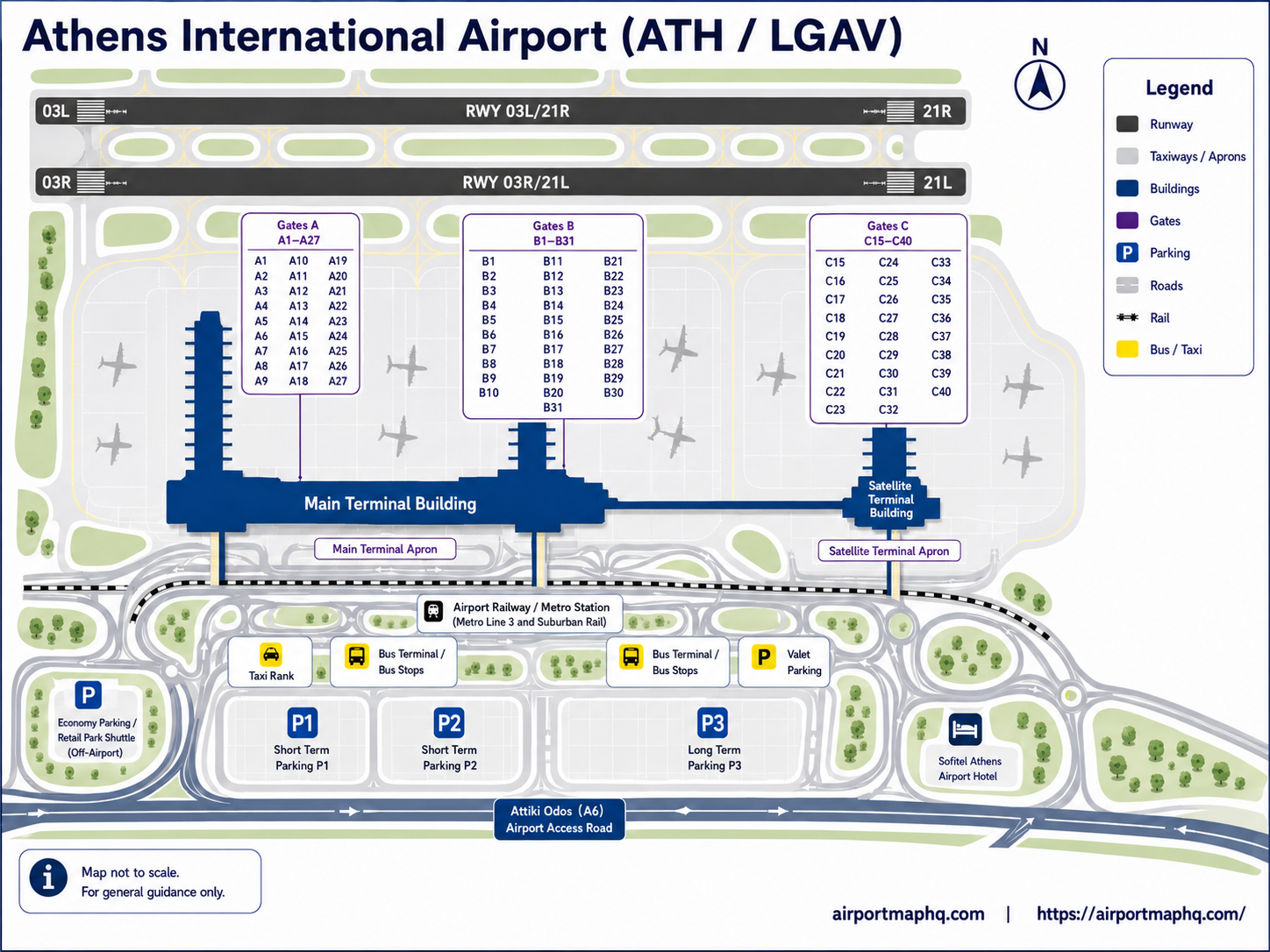 Click image to view full size
Athens Airport Location Map
Athens International Airport sits in the Spata area of Attica, about 20 km east of central Athens as the crow flies and roughly 30 km by road due to the hills. The Athens Airport location map below shows the airport’s position east of the city relative to the motorway network. Access from Athens is primarily via the Attiki Odos toll ring road, which connects directly to the airport entrance.
Athens Airport Terminals
Athens Airport operates two terminal buildings: the Main Terminal, which handles the vast majority of flights throughout the year, and the Satellite Terminal, a smaller dedicated building used mainly during the summer peak season. Both are within the same secure airside zone and connected by an underground walkway.
Three levels: Arrivals (ground floor), Departures (first floor) and a Food Court level. The Departures level splits into two halls by destination type. Arrivals has multiple baggage carousels on both the north and south sides.
Two levels: Arrivals and Departures. Significantly smaller than the Main Terminal, designed for overflow Schengen capacity during peak summer months. Connected to the Main Terminal via an underground walkway.
If your gate is in the Satellite Terminal, allow extra walking time from check-in. The underground corridor has moving walkways, but the total transfer can take 5–10 minutes.
Athens Airport Gate Areas — A, B and C
Understanding which gate area you need saves time at ATH. The split is determined by your destination type, not your airline. Non-Schengen and intercontinental flights depart from Gate A in the Main Terminal. Schengen and domestic flights leave from Gate B in the Main Terminal. During summer, extra Schengen capacity is provided at Gate C in the Satellite Terminal.
All flights to non-Schengen countries: UK, USA, Canada, Middle East, Africa, Asia, and other non-EU destinations. Also covers non-Schengen European routes including to Turkey, Russia and non-Schengen Balkan states.
All domestic flights within Greece (Thessaloniki, Santorini, Crete, Rhodes, Mykonos, Corfu, Kos and other islands) and flights to Schengen Area countries including Germany, France, Spain, Italy, Netherlands, and all other EU Schengen members.
Gate C in the Satellite Terminal is primarily active during the high summer tourist season when the Main Terminal reaches capacity. It handles additional Schengen flights, mainly operated by budget carriers and charter airlines serving Greek island routes.
Always check your boarding pass for your gate assignment and monitor the flight information screens — gates at ATH can change. If you are assigned to the Satellite Terminal, proceed via the underground walkway from the Main Terminal after clearing security.
Athens Airport Security
Security at Athens Airport is managed by the Hellenic Civil Aviation Authority. After check-in, passengers proceed to the relevant security checkpoint depending on their destination type. Non-Schengen passengers (Gate A) pass through passport control in addition to security screening. Domestic and Schengen passengers (Gate B) pass through security only. Passengers connecting to the Satellite Terminal pass through security in the Main Terminal first.
Airlines at Athens Airport
Athens Airport is the home base for Aegean Airlines, Greece’s largest carrier, and its subsidiary Olympic Air. Ryanair, Sky Express, Volotea and Cyprus Airways all use ATH as an operating base. In 2025, 70 airlines served 164 destinations across 55 countries, making Athens the second-best-connected international airport in Europe by that measure (up from 21st in 2019). Major carriers from across Europe, the Middle East, North America and beyond serve ATH.
Getting to Athens Airport
Ground transport connections from and to ATH are well developed. The Metro Line 3 (Blue Line) station is located directly inside the airport complex, accessible from the Departures level via a covered walkway. All bus services depart from the Arrivals level between Exits 4 and 5. Taxis are available at Exit 3 of the Arrivals level.
Athens Airport Parking
Pre-booking parking online at aia.gr provides significant discounts versus turning up and paying at the barrier. The first 20 minutes are free at all car parks. No parking in front of the terminal is permitted.
Athens Airport — Arrivals
Passengers arriving on domestic and Schengen flights deplane and proceed directly to baggage claim on the Arrivals level of the Main Terminal or Satellite Terminal. Arriving passengers on non-Schengen and international flights clear passport control (Customs and Border Control) in the Gate A area before collecting bags and exiting into the public Arrivals hall. Non-EU/EEA nationals are now subject to biometric checks under the EU Entry/Exit System (active from 30 March 2026), which may extend passport control waiting times.
Ground Transport from Arrivals
Metro Line 3 is accessed via a covered elevated walkway from the Arrivals level. Bus stops for X93, X95, X96 and X97 are located between Exits 4 and 5 of the Arrivals hall. Taxis queue at Exit 3. Car rental desks are inside the terminal at the Arrivals level. P1 and P2 short-term parking are directly across the road from Arrivals, reachable in two minutes on foot.
Athens Airport — Departures
The Departures level is on the first floor of the Main Terminal. Check-in is handled at 144 desks spread across the hall. After check-in, proceed to the relevant security and passport control area depending on your flight type: Gate A (right side of the hall) for non-Schengen and international flights, Gate B (left side) for Schengen and domestic. If departing from the Satellite Terminal (Gate C), proceed through security in the Main Terminal first, then follow signs to the underground walkway.
Recommended Check-In Times
For domestic flights within Greece, aim to be at check-in at least 90 minutes before departure. For Schengen flights, allow 2 hours. For non-Schengen and long-haul international departures, allow 2.5 to 3 hours, as passport control queues can be considerable, particularly since the EES biometric system went live in March 2026. Bag drop typically closes 45 minutes before departure.
Athens Airport Expansion (2026–2032)
Athens Airport is in the early stages of one of the largest infrastructure investments in Greek aviation history. The €1.3 billion programme aims to raise annual capacity to 40 million passengers by 2032. Up to half of the total works are expected to be complete by 2028. Key elements include a 68% increase in terminal space (150,000 sqm added across both the Main and Satellite buildings), a new 7-storey car park replacing P1 (due 2027), 32 new Code C aircraft stands on the northwest apron (due 2027), a dedicated 600 sqm VIP terminal for heads of state (due 2027), and doubled commercial space throughout. Contractor selection for the terminal expansion is expected in the second half of 2026, with construction to follow.
Athens Airport Insider Tips
ATH is compact and well-signed but can get very busy during summer. Know your gate area (A, B or C) before you arrive — it determines which side of the Departures hall you need. If you are connecting from a Greek island domestic flight (Gate B) to an international non-Schengen flight (Gate A), you will need to clear passport control between the two. Allow at least 90 minutes for such connections. The Metro is almost always faster than a taxi in morning and evening rush hours, and at €9 it is far cheaper. The Food Court level above Departures is generally less busy than the post-security restaurants and a good option before you check in. Store your parking ticket safely — lost ticket fees are significant.
Athens Airport Map — FAQ
How many terminals does Athens Airport have?
Two: the Main Terminal (open year-round) and the Satellite Terminal (used mainly in the peak summer season). Both are connected by an underground walkway. The Main Terminal is the primary hub for check-in, security, baggage claim and ground transport.
What are Gates A, B and C at Athens Airport?
Gate A (Main Terminal) is for non-Schengen and international departures. Gate B (Main Terminal) is for Schengen and domestic departures. Gate C (Satellite Terminal) handles additional Schengen capacity during peak summer. Your boarding pass or the flight information screens will confirm your gate.
Which airlines use Athens Airport?
Aegean Airlines and Olympic Air are based at ATH. Ryanair, Sky Express, Volotea and Cyprus Airways operate from ATH as a base. In 2025, 70 airlines served 164 destinations in 55 countries. Long-haul carriers include Emirates, Qatar Airways, Etihad and Turkish Airlines.
How do I get from Athens Airport to the city centre?
Metro Line 3 (Blue Line) runs directly from the airport to Syntagma Square in about 40 minutes. €9 one-way. Trains run every 30 minutes from 06:30 to 23:30. The X95 express bus to Syntagma costs €5.50 and runs 24 hours. Taxis charge a flat rate of €40 (day) or €55 (midnight to 05:00).
How far is Athens Airport from the city centre?
About 20 km east of central Athens by straight line, 30 km by road via the Attiki Odos motorway. Metro: 40 minutes. Taxi: 35–50 minutes depending on traffic.
Where can I park at Athens Airport?
P1 and P2 short-term (1,360 spaces, 2-minute walk, €25/day). P3 long-term (5,800 spaces, free shuttle, from ~€13/day, capped at €50 for 5 or more days). Executive Valet at Departures Entrance 3. Pre-book at aia.gr for discounts. First 20 minutes are free at all car parks.
Is there a new expansion at Athens Airport?
Yes. A €1.3 billion programme is under way targeting 40 million passengers annually by 2032. Works include a 68% increase in terminal space, a new 7-storey car park replacing P1 (due 2027), 32 new aircraft stands (due 2027), a new VIP terminal (due 2027), and doubled commercial space. Up to 50% of works should be complete by 2028.
What is the EU Entry/Exit System and does it affect Athens Airport?
The EES launched across the Schengen Area on 30 March 2026. Third-country nationals (non-EU/EEA/Swiss) are now subject to biometric registration at passport control when entering or leaving the Schengen Area. This affects Gate A departures and arrivals at ATH. Athens Airport recommends arriving at least 2.5 hours before departure to allow for the additional processing time.
What does the Athens Airport map show?
The Athens Airport map shows the Main Terminal and Satellite Terminal, the Gate A (non-Schengen), Gate B (Schengen/domestic) and Gate C (Satellite, seasonal) areas, the underground connecting walkway, security checkpoints, baggage claim halls, P1/P2 short-term and P3 long-term parking, Metro Line 3 station, suburban railway station, taxi rank and express bus stops, and access roads via the Attiki Odos motorway.
Can I walk between the Main Terminal and Satellite Terminal?
Yes. An underground corridor with moving walkways connects the two buildings. The walk takes approximately 5–10 minutes. Security is cleared in the Main Terminal before proceeding to the Satellite Terminal — there is no separate checkpoint in the Satellite building.