Heathrow Airport Map & Terminal Guide 2026
Four terminals, 115 gates, 214 destinations. Everything you need to navigate London Heathrow Airport (LHR) — Europe’s busiest airport and the UK’s primary international gateway.
Heathrow Airport Map
The Heathrow Airport map below shows the full layout of London Heathrow Airport (LHR/EGLL). Heathrow handled 84.5 million passengers in 2025, setting a new all-time record and cementing its position as Europe’s busiest airport and the fifth busiest in the world by passenger traffic. It is the primary hub for British Airways and a major operating base for dozens of airlines serving 214 destinations across 84 countries.
As the Heathrow Airport map shows, the layout spans two runways with four active terminals. Terminals 2 and 3 sit in the central area and share a rail station. Terminal 4 is located to the south, near the cargo terminal, while Terminal 5 sits to the west with its own dedicated station. Each terminal serves distinct airlines and alliances, so knowing which terminal your flight uses before you arrive is essential. Study the LHR airport map below to plan your route.
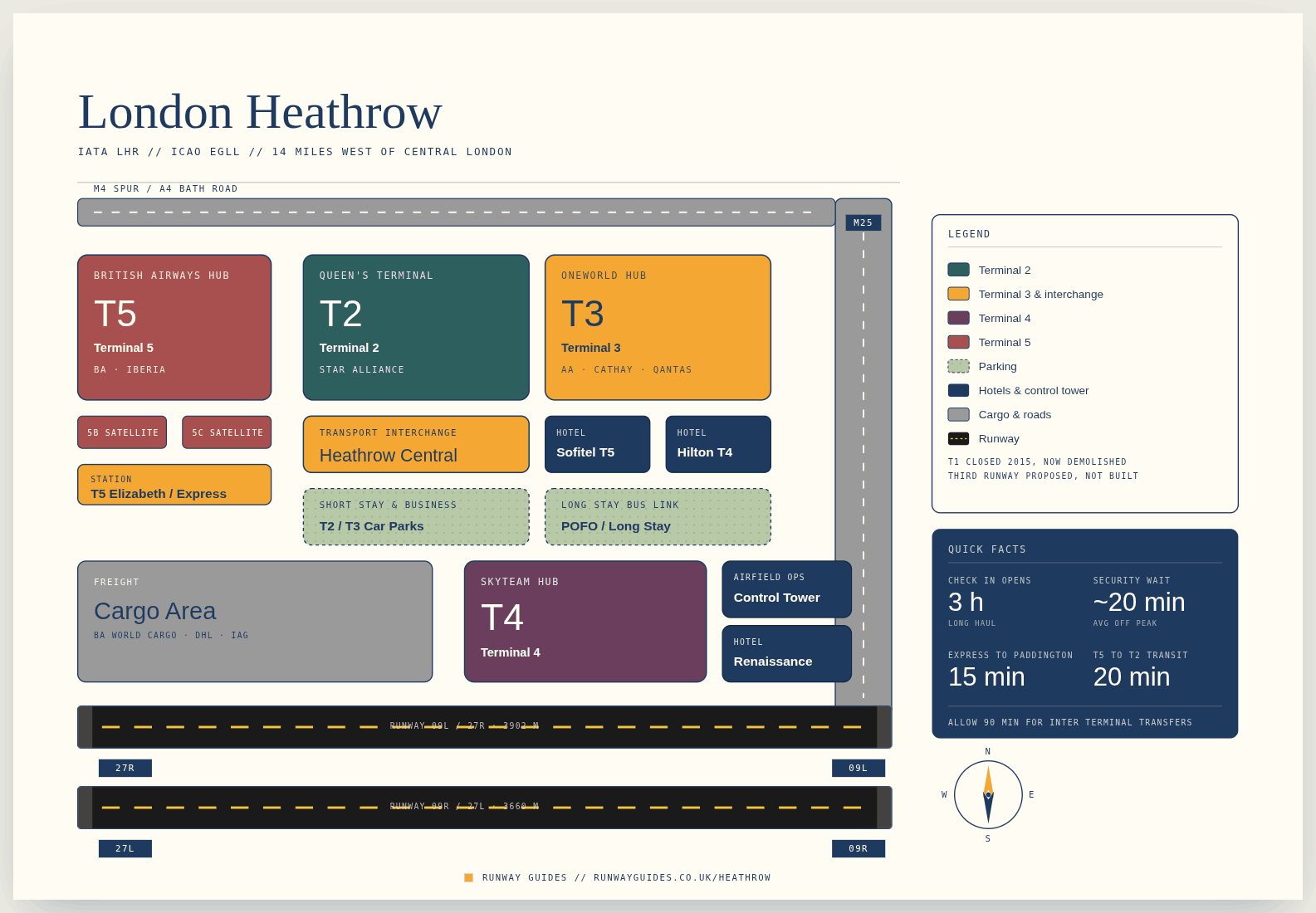 Click image to view full size
Heathrow Airport Location Map
London Heathrow Airport sits approximately 14 miles (23 km) west of central London in the Borough of Hillingdon. The interactive location map below shows LHR’s position relative to the city. The airport lies near the junction of the M4 and M25 motorways, making it straightforward to reach from most of southern England by road. Three rail services connect Heathrow directly to central London.
Heathrow Airport Terminals
Heathrow has four active terminals: Terminal 2, Terminal 3, Terminal 4 and Terminal 5. Terminal 1 closed to passengers in 2015 and is being demolished to allow for a future expansion of Terminal 2. Each terminal has its own check-in area, security checkpoint, departure lounge and baggage claim. Terminals 2 and 3 are connected by a short pedestrian walkway and share a rail station. Terminals 4 and 5 each have their own dedicated rail stations. Knowing your terminal before you arrive will save you significant time.
Heathrow Airport Terminal 2 (Queen’s Terminal)
Terminal 2, nicknamed the Queen’s Terminal, is Heathrow’s newest terminal building, having opened in June 2014 following a major rebuild of the original 1955 structure. It is the exclusive London base for Star Alliance member airlines and handled over 18.5 million passengers in recent years. The terminal comprises two buildings: the main T2A building and a satellite pier called T2B, linked by an underground walkway. Terminal 2 was the first Heathrow terminal to implement CT security scanners throughout, which means the 100ml liquid restriction no longer applies here. Note that a new purpose-built accessibility assistance area and a dedicated baggage system are both under construction as of 2026.
T2B is the satellite pier, reached via underground walkway from gate A16. Gates A16 to A26 are on level 4 with additional shops and duty-free. A new construction-era accessibility area is being added landside in 2026. CT scanners mean no 100ml liquid restrictions in Terminal 2.
Heathrow Airport Terminal 3
Terminal 3 handles the most diverse mix of airlines at Heathrow. It is the primary home of most oneworld members not based in Terminal 5, and also hosts several major SkyTeam carriers and significant independent airlines. Emirates operates multiple daily Airbus A380 services from here. Virgin Atlantic, now part of the SkyTeam alliance, uses Terminal 3 as its Heathrow base. British Airways also uses Terminal 3 for selected routes when capacity at Terminal 5 is constrained. Terminal 3 is located next to Terminal 2 and the two are connected by a pedestrian walkway taking around 10 minutes on foot.
Check-in is on the ground floor. After security on level 1 you reach the departures lounge with shops and restaurants. Gates 1 to 11 are to the left of the main exit. Gates 13 to 22 require a 10-minute walk through a corridor with moving walkways. The Virgin Atlantic Upper Class Wing provides expedited check-in on level 1 before security. A Plaza Premium arrivals lounge (open 06:00 to 14:00) and an American Airlines arrivals lounge are both available post-customs at T3.
Heathrow Airport Terminal 4
Terminal 4 sits on the south side of the airport, below the southern runway, and is geographically separate from the central terminal area. It has its own road access and its own Elizabeth line station. The terminal primarily serves SkyTeam members not based at Terminal 3, plus a range of long-haul carriers outside the major alliances. In 2026 a revamp is underway covering a new multi-storey car park and an upgraded check-in area. ITA Airways, which previously used Terminal 4, moved to Terminal 2 in March 2026.
Terminal 4 is the only terminal located below the southern runway. Its compact layout means gates are relatively close to the departure lounge. Check-in is on level 2 with an elevated roadway for drop-off. The Elizabeth line station is on level -1 beneath the arrivals hall. Allow 20 minutes for inter-terminal transfers to or from Terminals 2, 3 or 5. Construction activity is ongoing in 2026 so expect some temporary changes to the check-in layout.
Heathrow Airport Terminal 5 — British Airways Hub
Terminal 5 is the exclusive home of British Airways at Heathrow, handling the airline’s vast domestic, European and long-haul network from London. It opened in March 2008 and covers an area roughly the size of 50 football pitches, making it the UK’s largest freestanding building. The terminal has three parts: the main T5A building and two satellite concourses, T5B and T5C, both reached by automated transit within the secure zone. British Airways operates the majority of its Heathrow services from Terminal 5, though some routes use Terminal 3 when T5 capacity is constrained. Note that from 29 March 2026, Heathrow confirmed that certain flights are moving from Terminal 5 to Terminal 3 — always check your specific flight.
T5A is the main departures and arrivals building. T5B and T5C are satellite piers reached by a short automated transit train within the secure airside zone. The Terminal 5 rail station in the basement serves both the Heathrow Express (21 minutes to Paddington) and the Elizabeth line (roughly 31 minutes to Paddington). The north end of Terminal 5 typically has shorter security queues.
Heathrow Airport Security
Each of Heathrow’s four terminals has its own security checkpoint. You cannot move between terminals airside without clearing security again at the receiving terminal (except for booked flight connections, where airside shuttle buses are provided). Security wait times at Heathrow in 2024 were strong, with 92% of passengers clearing in under five minutes according to airport data. CT scanners are fully deployed in Terminal 2, removing the 100ml liquid restriction there. Terminals 3, 4 and 5 are progressively rolling out CT scanning.
Getting Between Terminals at Heathrow
Moving between Heathrow’s terminals requires planning. Terminals 2 and 3 are the only pair directly connected — you can walk between them via a pedestrian tunnel in around 10 minutes. All other terminal changes require using rail services or buses. Inter-terminal transfers are free when using the Heathrow Express or Elizabeth line within the airport boundary, though you need to tap in and out using an Oyster card or contactless payment (no charge is applied for travel between Heathrow terminals only).
| From | To | Method | Approx. Time |
|---|---|---|---|
| Terminal 2 | Terminal 3 | Pedestrian walkway (underground) | ~10 min |
| Terminal 2 or 3 | Terminal 5 | Free Heathrow Express (inter-terminal ticket) | ~3 min by train, ~20 min door to door |
| Terminal 2 or 3 | Terminal 4 | Free Elizabeth line from Heathrow Central station | ~5 min by train, ~20 min door to door |
| Terminal 5 | Terminal 2 or 3 | Free Heathrow Express (inter-terminal ticket) | ~3 min by train, ~20 min door to door |
| Terminal 5 | Terminal 4 | Heathrow Express to central area, then Elizabeth line | ~20 min |
| Terminal 4 | Terminal 2 or 3 | Free Elizabeth line to Heathrow Central station | ~5 min by train, ~20 min door to door |
Getting to Heathrow Airport
Three rail options, coaches, taxis, ride-shares and car hire all serve Heathrow. Heathrow Central station (for Terminals 2 and 3) and Terminal 5 station are the two rail hubs. Terminal 4 has its own Elizabeth line station. All stations are within the paid parking area, so arriving by train avoids the drop-off charge that applies to vehicles at the terminal forecourts. Visit heathrow.com for a live journey planner tool covering all transport modes.
Heathrow Airport Parking
Heathrow has short-stay, long-stay and business parking across all four terminals. On-airport parking is expensive for longer trips — pre-booking in advance through heathrow.com will save a significant amount versus turning up without a reservation. Drop-off and pick-up zones at terminal forecourts now carry a charge for private vehicles, so using public transport or the official pick-up zones is advisable.
Heathrow Airport Map — Arrivals
Arriving passengers follow signs for arrivals immediately after disembarking. UK and EU nationals with biometric passports can use eGates at all four terminals, which are generally faster than staffed desks. International passengers from outside the UK use staffed border force lanes. Baggage reclaim carousels are displayed on screens in the arrivals hall. Each terminal has its own ground transportation zone outside arrivals with taxi ranks, ride-share pick-up bays, rail station access and hotel shuttle bus stops.
Arrivals by Terminal
At Terminal 2, arrivals are at level 1 and ground transportation is reached via level 0, with rail connections at level -1 via the underground walkway. Terminal 3 arrivals are on level 1, with the Plaza Premium arrivals lounge and American Airlines arrivals lounge available post-customs for eligible passengers. Terminal 4 arrivals clear immigration on the mezzanine above arrivals level, then collect baggage at ground level. The Elizabeth line station is on level -1. Terminal 5 arrivals emerge into a large hall with rail connections directly below in the basement station.
Heathrow Airport Map — Departures
Departing passengers must go to the correct terminal first — there is no airside link between terminals for outbound passengers. Check your booking confirmation for your terminal, or use the airline search on heathrow.com. At each terminal, check in at your airline’s desk or a self-service kiosk, drop your bags if needed, then proceed to the security checkpoint. Once airside you have full access to the departures lounge, restaurants, shops and your departure gate.
Recommended Departure Times
Arrive at your terminal at least 3 hours before long-haul international departures and 2 hours before short-haul European flights. Check-in desks typically close 60 minutes before departure for long-haul and 45 minutes for short-haul. Gate close times are strictly enforced at Heathrow. If travelling during peak morning hours (05:00 to 09:00) or over school holidays, add extra buffer time, particularly for security.
Heathrow Airport Lounges
Each terminal has a distinct lounge landscape. Terminal 2 offers airline-specific Star Alliance lounges including Lufthansa, Air Canada and Singapore Airlines facilities, plus independent paid-access options. Terminal 3 has one of Heathrow’s strongest lounge lineups: the Virgin Atlantic Clubhouse (widely regarded as one of the best airport lounges in the world), the Amex Centurion Lounge, the No1 Lounge, the American Airlines Admirals Club, and the Qantas Business Lounge. Terminal 4 is thinner on lounge options but Qatar Airways, Gulf Air and Saudia all operate airline lounges there. Terminal 5 is dominated by British Airways’ extensive tiered lounge offering across all classes of travel, from the Galleries Club through to First. Access to non-airline lounges can be arranged via Priority Pass, Lounge Key, an Amex Platinum card or direct day-pass purchase.
Insider Tips for Heathrow
Heathrow is large and each terminal functions as a standalone airport — arriving at the wrong terminal for your flight will cost you at least 30 minutes. Always double-check your terminal on the day of travel, as some airlines use different terminals for different routes. Security wait times are generally shortest before 05:30 and after 21:00. The Elizabeth line is the best value rail option into central London for most passengers — the ticket machines near the Heathrow Express entry barriers are set up to sell the more expensive Heathrow Express by default. For Terminal 4, take the Elizabeth line from Heathrow Central station rather than attempting to drive between terminals. If connecting between flights, follow Flight Connections signs immediately after landing and do not stop to shop or eat until you have confirmed your onward gate. Refer to the Heathrow Airport map above to understand the layout before you travel.
Heathrow Airport Map — FAQ
How many terminals does Heathrow Airport have?
Four active terminals: Terminal 2 (Queen’s Terminal), Terminal 3, Terminal 4 and Terminal 5. Terminal 1 closed in 2015 and is being demolished. Always check your booking to confirm which terminal your airline uses.
Which airlines use Terminal 2 at Heathrow?
Terminal 2 is exclusively used by Star Alliance member airlines including Lufthansa, United Airlines, Air Canada, Singapore Airlines, ANA, Aer Lingus, Swiss, Austrian, TAP Air Portugal, Turkish Airlines, ITA Airways (from March 2026), Brussels Airlines, Eurowings, Icelandair, JetBlue, Loganair and other Star Alliance carriers.
Which airlines use Terminal 3 at Heathrow?
Terminal 3 serves a mix of oneworld, SkyTeam and independent carriers. Key airlines include American Airlines, Cathay Pacific, Japan Airlines, Qantas, Emirates, Virgin Atlantic, Delta, Air France, KLM, Aeromexico, LATAM and British Airways on selected routes.
Which airlines use Terminal 4 at Heathrow?
Terminal 4 handles SkyTeam and non-aligned long-haul airlines including China Eastern, Kenya Airways, Korean Air, Saudia, TAROM, Vietnam Airlines, Malaysia Airlines, Qatar Airways, Etihad Airways and Gulf Air.
Which airlines use Terminal 5 at Heathrow?
British Airways exclusively, operating from the T5A main building and T5B and T5C satellite concourses. Some BA flights depart from Terminal 3 due to capacity. Always check your specific booking.
How do I travel between terminals at Heathrow?
Terminals 2 and 3 are linked by a pedestrian walkway (around 10 minutes on foot). Between Terminals 2/3 and Terminal 5, use the free Heathrow Express inter-terminal transfer (3 minutes by train, about 20 minutes door to door). Terminal 4 is served by the free Elizabeth line from Heathrow Central station. Airside flight connection shuttle buses run every 6 to 10 minutes for passengers with booked connections.
What is the fastest way from Heathrow to central London?
The Heathrow Express. It takes 15 minutes from Terminals 2 and 3 to Paddington, or 21 minutes from Terminal 5. Walk-up standard single tickets are £26; advance tickets start from £10 when booked 30 or more days ahead. The Elizabeth line is a good mid-price alternative at roughly £15.50, taking around 29 to 30 minutes to Paddington. The Piccadilly line is cheapest at around £5.90, taking around 49 minutes.
How far is Heathrow from London?
Approximately 14 miles (23 km) west of central London. By Heathrow Express: 15 minutes to Paddington. By Elizabeth line: around 30 minutes to Paddington. By Piccadilly line: around 49 minutes. Driving can take 30 to 75 minutes depending on traffic and time of day.
Is the 100ml liquid rule enforced at Heathrow?
In Terminal 2, no — CT scanners have fully replaced the 100ml restriction, and liquids up to 2 litres do not need to be removed from bags. In Terminals 3, 4 and 5, CT roll-out is ongoing — check current Heathrow guidance before your trip as rules may differ between checkpoints.
What does the Heathrow Airport map show?
The Heathrow Airport map shows the location of all four terminals, rail stations, the motorway access roads (M4 and M25), inter-terminal transfer routes, parking zones, and the broader layout of the airport between its two runways.