London City Airport Map & Terminal Guide 2026
One terminal, two piers, 15 gates. Everything you need to navigate London City Airport (LCY) — the most central airport in London, purpose-built for business travellers and just 22 minutes from Bank by DLR.
London City Airport Map
The London City Airport map below shows the complete layout of LCY, located in the Royal Docks area of East London. London City Airport (IATA: LCY, ICAO: EGLC) handled 3.57 million passengers in 2024 and is the fifth-busiest airport serving the London area, behind Heathrow, Gatwick, Stansted and Luton. It is the most centrally located of London's airports and the only one with a dedicated DLR station directly connected to the terminal building.
As the London City Airport map shows, the layout is compact and vertical rather than sprawling. Everything happens in a single two-storey building: check-in desks on the ground floor, escalators up to security on the first floor, then two departure piers descending back to ground level for boarding. There are no jet bridges at LCY — all 15 gates are hardstands, meaning passengers walk across the apron to board the aircraft. Study the LCY airport map before you travel and you will find it one of the fastest airports in London to navigate.
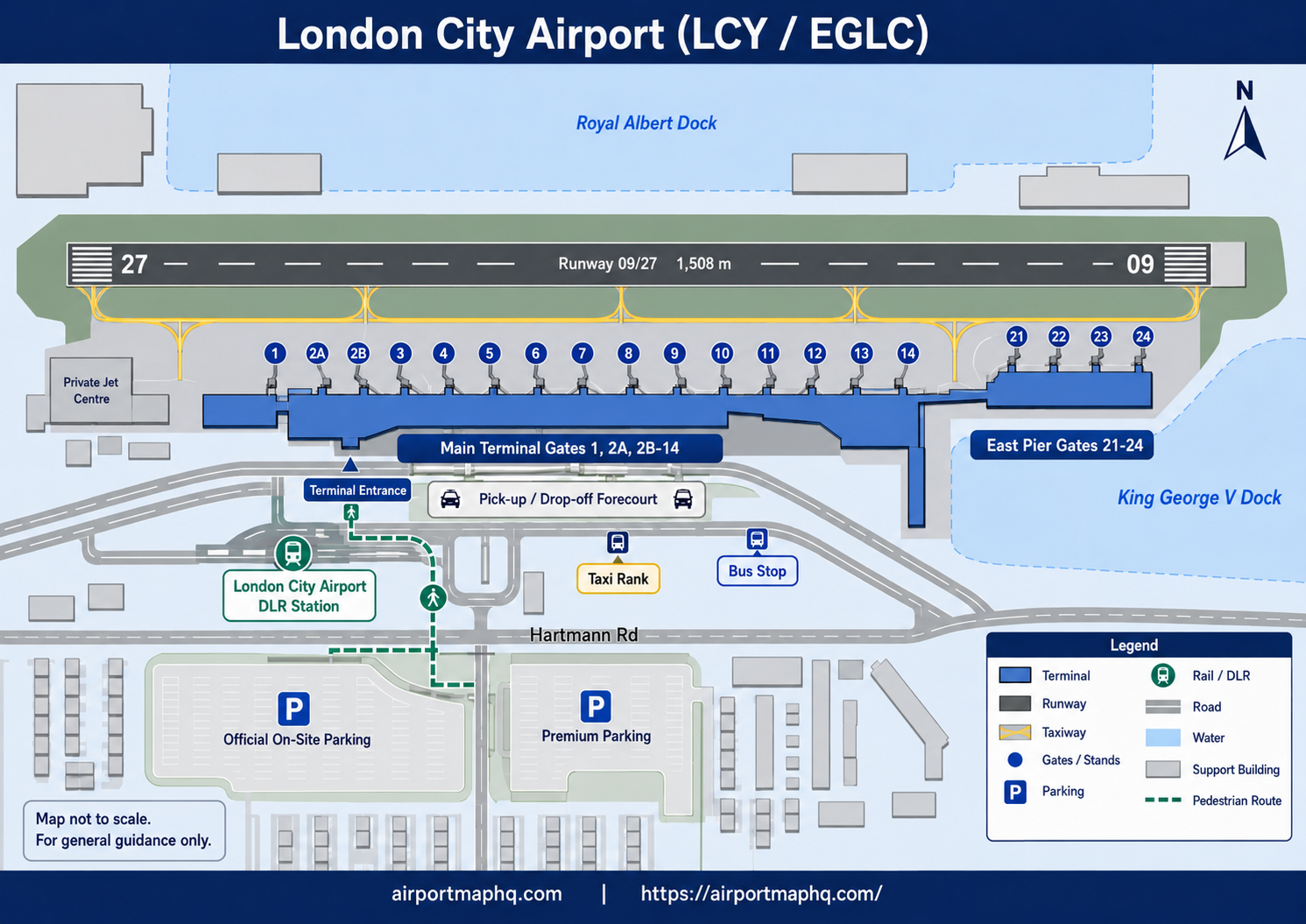 Click image to view full size
London City Airport Location Map
London City Airport sits in the Royal Docks area of East London, approximately 6 miles (10 km) east of the City of London and 3 miles (5 km) east of Canary Wharf. The map below shows its position relative to central London. The airport occupies a strip of land between the Royal Albert Dock to the north and King George V Dock to the south — a geography that constrains the site significantly and keeps the runway at just 1,508 metres. Access by road is via the A1020 and A1011, connecting to the A13 and North Circular.
Interactive map showing London City Airport's location in the Royal Docks area of East London
View Larger Map
London City Airport Terminal Layout
London City Airport has a single terminal building arranged over two levels. The layout is vertical and compact, which is what makes it so fast to navigate — from kerb to gate in under 20 minutes is routine for hand-luggage passengers.
Ground Floor: Check-In and Arrivals
The ground floor of the terminal contains all airline check-in desks, bag drop counters, currency exchange facilities, ATMs, and the main entrance. Arriving passengers exit onto the ground floor via the baggage claim hall, which has both domestic and international arrival lanes. Ground transportation, taxis and the DLR station entrance are all accessed from the ground floor.
First Floor: Security and Departure Lounge
A central bank of escalators and stairs leads from the check-in hall up to the first-floor security checkpoint. Boarding pass scanners (e-gates) are positioned at the top of the escalators. Once through security, the airside departure lounge runs across the full width of the building, with shops, cafes and restaurants on both sides. Corridors from the first floor then descend to the ground-level gates via the west pier on the left and the east pier on the right.
London City Airport Departure Piers
After clearing security, the departure lounge connects to two boarding piers: the west pier and the east pier. Corridors from the upper floor descend to ground level, where passengers exit onto the apron and walk to their aircraft. No jet bridges are used at LCY. All gates are hardstands, and boarding is always done on foot across the apron, so dress appropriately for weather conditions.
The west pier was refurbished as part of a £15 million investment programme in 2013, delivering new departure gates, improved seating and updated concession areas. It handles a mix of British Airways and other carrier departures depending on the day's schedule. Gate assignments are dynamic and shown on screens throughout.
The east pier was added following planning permission granted in 2001 and became operational in May 2008. It added four additional aircraft parking stands and gates, physically carried on piles above the water of King George V Dock. From these gates you have a clear runway view and can see aircraft manoeuvring on the apron. As with the west pier, gate assignments are dynamic.
Airlines at London City Airport
Around eight airlines serve London City Airport, connecting LCY to more than 30 destinations across Europe and the UK domestic network. British Airways and its regional subsidiary BA CityFlyer operate the most flights by a significant margin. There are no long-haul services from LCY as of 2026, following British Airways' suspension of the New York JFK route in 2020.
London City Airport Security
There is a single security checkpoint at London City Airport, located on the first floor at the top of the central escalators from the check-in hall. Boarding pass scanners (e-gates) sit immediately in front of the security lanes. All passengers use the same checkpoint regardless of airline or destination.
Getting to London City Airport
London City Airport has excellent public transport connections to East London. The DLR is by far the most popular choice, used by roughly 70% of passengers. The airport falls just outside the Congestion Charge zone, so driving is not penalised by that charge but on-site parking is expensive.
London City Airport Parking
On-site parking at London City Airport is limited and expensive by London standards, reflecting the constrained site in the Royal Docks. Pre-booking is strongly recommended, especially for stays of more than one day. The DLR makes driving to LCY less necessary than at most London airports — many regular travellers simply do not drive here at all.
London City Airport Arrivals
Arriving at London City Airport is generally one of the fastest airport experiences available in London. Domestic UK arrivals deplane at a gate, walk through the pier corridor to the terminal and proceed straight to baggage claim on the ground floor. International arrivals clear passport control on the first floor before descending to baggage reclaim and the arrivals hall.
Ground Transportation from Arrivals
Everything is immediately outside the arrivals hall: the DLR station entrance is steps from the exit, black cabs queue along the terminal kerb, and the ride-hailing pick-up zone is clearly signed. Currency exchange (Global Exchange) is available in the arrivals hall both before and after customs. For the City and Canary Wharf, the DLR is almost always faster than road transport outside early mornings.
London City Airport Departures
All flights depart from the same terminal, so there is no risk of going to the wrong building. Check in at your airline's ground-floor desk or use self-service kiosks, drop checked bags at bag drop, then head up the escalators to security on the first floor. Once airside, all gates are accessible from the single departure lounge. Gate numbers appear on digital boards throughout — always check before walking down to a pier, as assignments are confirmed close to boarding time.
Recommended Departure Timeline
Arrive at least 90 minutes before departure for a standard off-peak flight. Allow 2 hours on Monday to Thursday mornings and Friday evenings, when LCY is at its busiest with business travellers. Bag drop closes 30 minutes before departure and check-in desks close 20 minutes before. Overnight bag drop is available at LCY between 18:00 and 20:30 for flights departing before 09:00 the following morning.
London City Airport Operating Hours
London City Airport has restricted operating hours compared to the other main London airports, a condition of its planning permission to minimise noise impact on local residents in East London.
Insider Tips for London City Airport
LCY is fast when it flows — kerb to gate in under 20 minutes is genuinely achievable with hand luggage. But it can back up quickly. The single security checkpoint is the one real pinch point: if the queue spills onto the mezzanine bridge, it is longer than it looks from below, so do not cut your arrival time too fine.
There are no departure announcements over the PA system at LCY. Watch the flight information screens religiously. Gates change and boarding calls are made only at the gate itself. If you are deep in a cafe, you could miss your flight without realising it.
The DLR is the right choice for the City and Canary Wharf almost every time. For West London, North London or South London, the multi-change DLR journey with luggage can be genuinely unpleasant. Pre-book a taxi or consider Heathrow if your origin is west of the centre. LCY aircraft are smaller than at other London airports (Embraer E190/E195 family rather than Boeing 737 or Airbus A320), so overhead bin space is more limited. Travel light or check bags to avoid gate-checking at the last minute.
London City Airport Map — FAQ
How many gates does London City Airport have?
London City Airport has 15 gates, all of which are hardstands. There are no jet bridges at LCY. Passengers walk across the apron to board, reaching the ground-level gates via corridors that descend from the upper-floor departure lounge through the west and east piers.
How do I get from London City Airport to central London?
The DLR is the default option for most passengers. London City Airport has its own DLR station directly inside the terminal. Trains run to Bank in around 22 minutes and Stratford in around 16 minutes. Change at Canning Town for the Jubilee line. Black cabs cost roughly £35 to £45 to central London.
Which airlines fly from London City Airport in 2026?
British Airways and BA CityFlyer are the dominant operator, serving Edinburgh, Glasgow, Belfast City, Amsterdam, Zurich, Geneva, Nice, Toulon, Barcelona, Madrid, Malaga, Ibiza, Palma, Skiathos and more. Other carriers include KLM, Swiss, ITA Airways, Luxair, LOT Polish Airlines, Air Dolomiti, Loganair, Aurigny and Aer Lingus.
Is there a lounge at London City Airport?
There is no lounge inside the main terminal building. British Airways does not have a lounge at LCY. Priority Pass is not accepted in the terminal. The only lounge option is the Private Jet Terminal, a paid facility in a separate building near the main terminal. Most passengers use the airside cafes and restaurants instead.
Does London City Airport have jet bridges?
No. Every gate at LCY is a hardstand. All passengers walk across the apron to board their aircraft. This applies to every airline and every flight. Dress for the weather — there is brief outdoor exposure between the terminal building and the aircraft door.
What is the drop-off charge at London City Airport?
In 2026 London City Airport introduced a drop-off charge of £8 to £13 for a maximum stay of 10 minutes. ANPR cameras record entry and exit automatically. Payment is due by midnight the following day. Blue Badge holders should check the airport website for any exemptions that may apply.
How far is London City Airport from the City of London?
Approximately 6 miles (10 km) east. By DLR to Bank station: around 22 minutes. By taxi: 20 to 40 minutes depending on traffic, costing roughly £35 to £45.
What are London City Airport's operating hours?
Monday to Friday: approximately 06:30 to 22:00. Saturday morning operations only — no Saturday afternoon flights. Sunday is effectively closed to scheduled commercial services. Always verify flight times directly as restricted operations can affect schedules.
What does the London City Airport map show?
The London City Airport map shows the single two-storey terminal building, ground-floor check-in, upper-floor security and departure lounge, west and east departure piers, all 15 hardstand gate positions, the DLR station, the short-stay and long-stay car parks, the drop-off forecourt, the runway over King George V Dock, and surrounding roads in the Royal Docks area.