Oslo Airport Map & Terminal Guide 2026
One terminal, four piers, 72 gates. Everything you need to navigate Oslo Airport Gardermoen (OSL) — Norway’s main international gateway and the second busiest airport in the Nordic countries.
Oslo Airport Map
The Oslo Airport map below shows the full layout of Oslo Airport Gardermoen (OSL/ENGM). OSL handled 26 million passengers in 2024 and serves as the primary hub for Scandinavian Airlines (SAS) and an operating base for Norwegian Air Shuttle, Widerøe and Norse Atlantic Airways. More than 40 airlines connect the airport to over 160 destinations across 31 domestic routes and 130 international ones.
As you can see on the Oslo Airport map, the layout is a single large terminal building with four piers extending outward. The West Pier holds the domestic A-gates. The South Pier covers remote B-stands used for Schengen flights. The North Pier, which opened in 2017 and earned a BREEAM Excellent sustainability rating, contains the C and D gates. The East Pier is split between Schengen international E-gates and non-Schengen F-gates, separated by a passport control checkpoint. Study the OSL terminal map before you travel so you know exactly which pier your gate sits on.
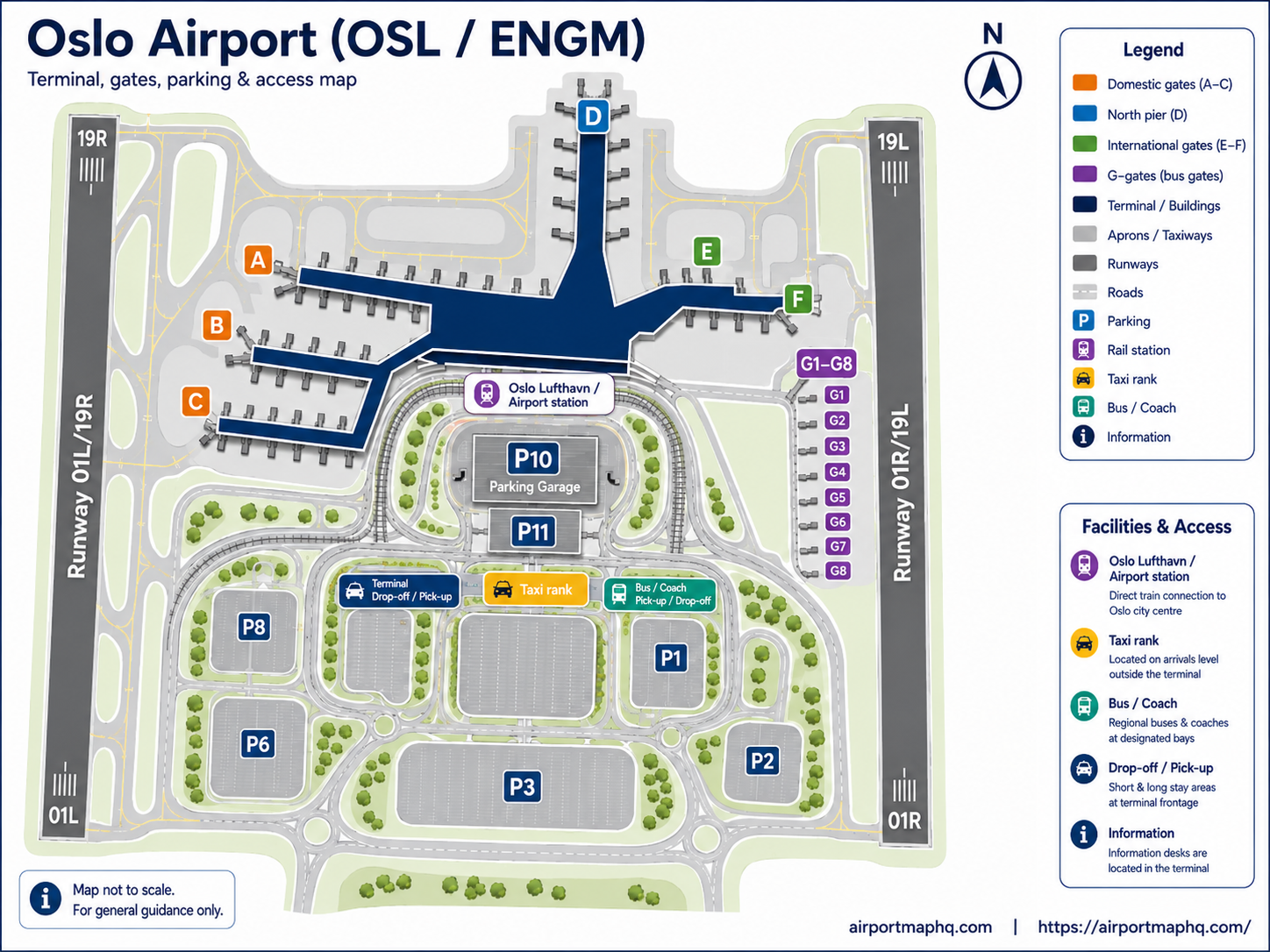 Click image to view full size
Oslo Airport Location Map
Oslo Airport Gardermoen sits approximately 35 km (22 miles) northeast of Oslo city centre, near the town of Gardermoen in Akershus county at the border of Nannestad and Ullensaker municipalities. The airport is accessed directly from the E6 motorway. The location map below shows OSL’s position relative to Oslo and the surrounding region.
Oslo Airport Terminal Layout
Oslo Airport operates from one large terminal building covering 265,000 square metres. Despite being a single terminal, it functions like multiple zones with hard separations between domestic, Schengen and non-Schengen areas. Passport control sits in the East Pier corridor between the E-gates and F-gates. Once through security in the Departures Hall, you can move freely between domestic and Schengen areas, but crossing to non-Schengen requires passing passport control.
The terminal has two levels at the main building: Level 2 (Arrivals and baggage claim) and Level 3 (Departures and check-in). The train station sits below the terminal at Level 1, directly accessible from the arrivals hall. All check-in counters are in the Departures Hall on Level 3, and gate access begins after security screening.
Oslo Airport Security Checkpoints
The main security checkpoint is located on Level 3 in the Departures Hall. Fast Track lanes are available to the left of the Point kiosk and can be accessed by passengers with Fast Track entitlement through their airline, frequent flyer status or ticket type. Security screening covers all passengers regardless of destination — the split between Schengen and non-Schengen flights happens later, at passport control in the East Pier.
Passport control is positioned in the East Pier corridor between the Schengen E-gates and the non-Schengen F-gates. Every passenger travelling to a destination outside the Schengen Area must clear passport control here before reaching the F-gate boarding areas. Passengers connecting from non-Schengen international arrivals to domestic flights need to collect baggage, clear customs and check in again for their onward flight.
Oslo Airport West Pier — A-Gates (Domestic)
The West Pier is the original domestic wing of the terminal and the largest pier by gate count. It handles the vast majority of domestic Norwegian flights and is accessible directly from the main Departures Hall after security. SAS, Norwegian and Widerøe all operate domestic routes from the A-gates. The SAS Domestic Lounge and the OSL Lounge are both located on this pier.
Popular domestic destinations from the A-gates include Bergen, Trondheim, Stavanger, Tromsø and Longyearbyen. The walk from security to the far end of the A-gates is roughly 550 to 600 metres, so allow enough time if your gate is at the western tip.
Oslo Airport South Pier — B-Gates and Remote Stands
The South Pier was built in 2012 as a temporary measure to offset gates lost during North Pier construction. It was originally intended for demolition after five years, but a moving walkway was added in 2018 and it is now a permanent fixture. The B-gates are primarily remote stands served by shuttle buses from the international area. From 2024, the South Pier has also been used for early morning Schengen international flights. When configured for international remote stands, passengers access them via shuttle bus from the G1 to G8 boarding area.
None of the B-gate stands have jet bridges. Passengers board via stairs and walk to the aircraft. If your boarding pass shows a B or G gate, head to the shuttle bus boarding point in the international Schengen area.
Oslo Airport North Pier — C and D Gates
The North Pier opened in April 2017 and was the first terminal pier in the world to receive a BREEAM Excellent sustainability rating. It uses recycled runway snow for energy, Scandinavian timber and recycled concrete throughout. The pier contains 11 gates split between domestic C-gates and Schengen international D-gates. The D2 gate area is also the location of the Domestic Transfer filter, used by connecting passengers arriving from Schengen international flights who need to board a domestic flight without leaving the airside zone.
Moving walkways connect the North Pier to the main terminal. The BREEAM Excellent rating reflects the pier’s energy-efficient design: snow from the runways is recycled to heat and cool the building, reducing reliance on external energy sources.
Oslo Airport East Pier — E and F Gates (International)
The East Pier handles all international flights outside the domestic and Schengen zones. It is divided into two sections: the E-gates for Schengen international flights (European destinations within the Schengen Area) and the F-gates for non-Schengen international flights to destinations outside the Schengen zone, including intercontinental routes. Passport control sits between the two sections. The SAS Business Lounge and the international OSL Lounge are located in the E-gate area before passport control.
Allow extra time for the East Pier during peak morning and early afternoon hours. The E-gate security area can get busy before popular European departures. If your flight is from an F-gate, clear passport control well before boarding begins. Walking from security to the far end of the F-gates takes around 10 minutes.
Getting Around Oslo Airport
Oslo Airport has one terminal so there are no inter-terminal shuttles. Within the terminal, moving walkways connect the North Pier to the main building and a moving walkway also links the South Pier. Walking from the domestic A-gates to the far end of the non-Schengen F-gates takes around 15 to 20 minutes. The key decision point is passport control in the East Pier: pass through it for non-Schengen F-gate departures, but do not pass through if your flight is a Schengen E-gate departure.
Connection Times at Oslo Airport
Domestic to domestic connections within the A and C gates are fast, typically 30 to 40 minutes minimum. Domestic to Schengen international connections require re-clearing security in some cases, so allow 60 minutes. Domestic to non-Schengen international connections are more complex: arriving international passengers must collect baggage, clear customs and re-check bags, so allow at least 90 minutes. Schengen to non-Schengen connections within the airside zone only require passing passport control, so 45 to 60 minutes is usually sufficient if gates are close.
Getting to Oslo Airport
All ground transport for arrivals is available from Level 2. The train station is on Level 1, directly below the arrivals hall and accessed by following train signs through the terminal.
Oslo Airport Parking
Oslo Airport has around 20,000 parking spaces across two indoor multi-storey car parks and eight outdoor lots. The parking system uses automatic licence plate recognition (Autopay) so there are no paper tickets. Payment is made via the Autopay app, at machines or within 48 hours online. Pre-booking via Avinor is always cheaper than drive-up rates, and prices are dynamic so booking early saves money.
Oslo Airport Map — Arrivals
Domestic arrivals land at the A or C gates and proceed directly to baggage claim on Level 2 without any passport or customs checks. Schengen international arrivals land at the D or E gates and collect bags on Level 2, then exit through the EU/Schengen exit channel in customs. Non-Schengen international arrivals land at F-gates, collect bags, and must pass through passport control (staffed immigration desks) and full customs on Level 2 before exiting into the public arrivals hall. All arrivals exit into the same main arrivals hall on Level 2, where trains, taxis and buses depart.
Oslo Airport Map — Departures
All airlines check in on Level 3 of the main terminal. There is one shared Departures Hall regardless of your destination. After check-in, proceed to the main security checkpoint, use Fast Track if available, and follow signs for your pier. Domestic and Schengen passengers proceed directly to their gate after security. Non-Schengen passengers turn right through the East Pier and clear passport control before reaching their F-gate.
Recommended Arrival Times
Arrive at least 2 hours before domestic and Schengen flights. Allow 3 hours before non-Schengen international flights, particularly for early morning departures when security and passport control are busiest. Check-in desks for most airlines close 45 minutes before departure. Gate assignments appear on screens throughout the terminal and on your airline’s app.
Oslo Airport Lounges
Insider Tips
Oslo Airport operates as a silent airport so there are no overhead announcements. Watch screens constantly. The East Pier E-gates get crowded during peak European departures in the 06:00 to 10:00 window, so arrive at the gate early if you are on a morning Schengen flight. The cheapest way into the city is the Vy regional train at around NOK 120, and it is only 4 minutes slower than the more expensive Flytoget Express. If connecting internationally to domestically, clear the D2 transfer filter before heading to the A-gates rather than exiting to the public arrivals area. The duty-free store at OSL is the largest in Europe and is worth leaving a few minutes for on outbound flights. Refer to the Oslo Airport map above to plan your route before you arrive.
Oslo Airport Map — FAQ
How many terminals does Oslo Airport have?
One terminal with four piers: West (A-gates, domestic), South (B-gates and remote G-stands), North (C domestic and D Schengen international) and East (E Schengen and F non-Schengen international). There are 72 gates in total, 44 with jet bridges.
How do I get from Oslo Airport to Oslo city centre?
Two train options: Flytoget Airport Express (19 min, NOK 230, every 10 min) or Vy regional train (23 min, NOK 114 to 129, every 20 min). Airport buses take 50 to 70 minutes. Taxis cost around NOK 900 to 1,100 for the 40-minute journey.
Which airlines use which gates at Oslo Airport?
A-gates (West Pier): domestic SAS, Norwegian and Widerøe. C-gates (North Pier): domestic flights. D-gates (North Pier): Schengen international. E-gates (East Pier): Schengen international including Ryanair, Wizz Air, easyJet and European carriers. F-gates (East Pier): non-Schengen and intercontinental including British Airways, KLM, Lufthansa, Emirates and Norse Atlantic Airways.
Where is security at Oslo Airport?
The main security checkpoint is on Level 3 in the Departures Hall. Fast Track is available to the left of the Point kiosk. Passport control is in the East Pier corridor between the Schengen E-gates and non-Schengen F-gates.
How far is Oslo Airport from the city centre?
Approximately 35 km northeast of Oslo city centre. The Flytoget Airport Express reaches Oslo S in 19 minutes. By taxi the journey takes around 40 minutes and costs NOK 900 to 1,100.
Where can I park at Oslo Airport?
P10 and P11 are the closest indoor options. P1 is outdoor but within walking distance. P2 through P7 are further out with a free shuttle bus. Around 20,000 spaces in total. Pre-booking via Avinor gives lower rates than drive-up pricing.
Is Oslo Airport a silent airport?
Yes. There are no general PA announcements across the terminal. Announcements are only made at each gate boarding area. Monitor flight information screens and your airline app throughout your visit.
What lounges are available at Oslo Airport?
The SAS Domestic Lounge is near Gate A2 for eligible SAS passengers. The OSL Lounge is near Gate A15 and open to all travellers for a fee (NOK 400 to 800 depending on how far before departure). The SAS Business Lounge is in the Schengen international area. An international OSL Lounge is also available for NOK 445.
Can I connect from an international flight to a domestic flight at Oslo Airport?
It depends on where you are arriving from. Schengen international arrivals can connect to domestic flights via the D2 transfer filter airside without leaving the terminal. Non-Schengen arrivals must collect baggage, clear customs and re-check bags, so allow at least 90 minutes for this connection.
What does the Oslo Airport map show?
The Oslo Airport map shows the single terminal building, all four piers (West, South, North and East), gate areas A through F and remote G-stands, security and passport control locations, baggage claim, the Flytoget and Vy train station on Level 1, parking areas P1 through P11, car rental, and E6 motorway access.