Palma Airport Map & Terminal Guide 2026
One terminal, four modules, 88 gates. Everything you need to navigate Palma de Mallorca Airport (PMI) — the third busiest airport in Spain and gateway to the Balearic Islands, currently undergoing its biggest overhaul in 30 years.
Palma Airport Map
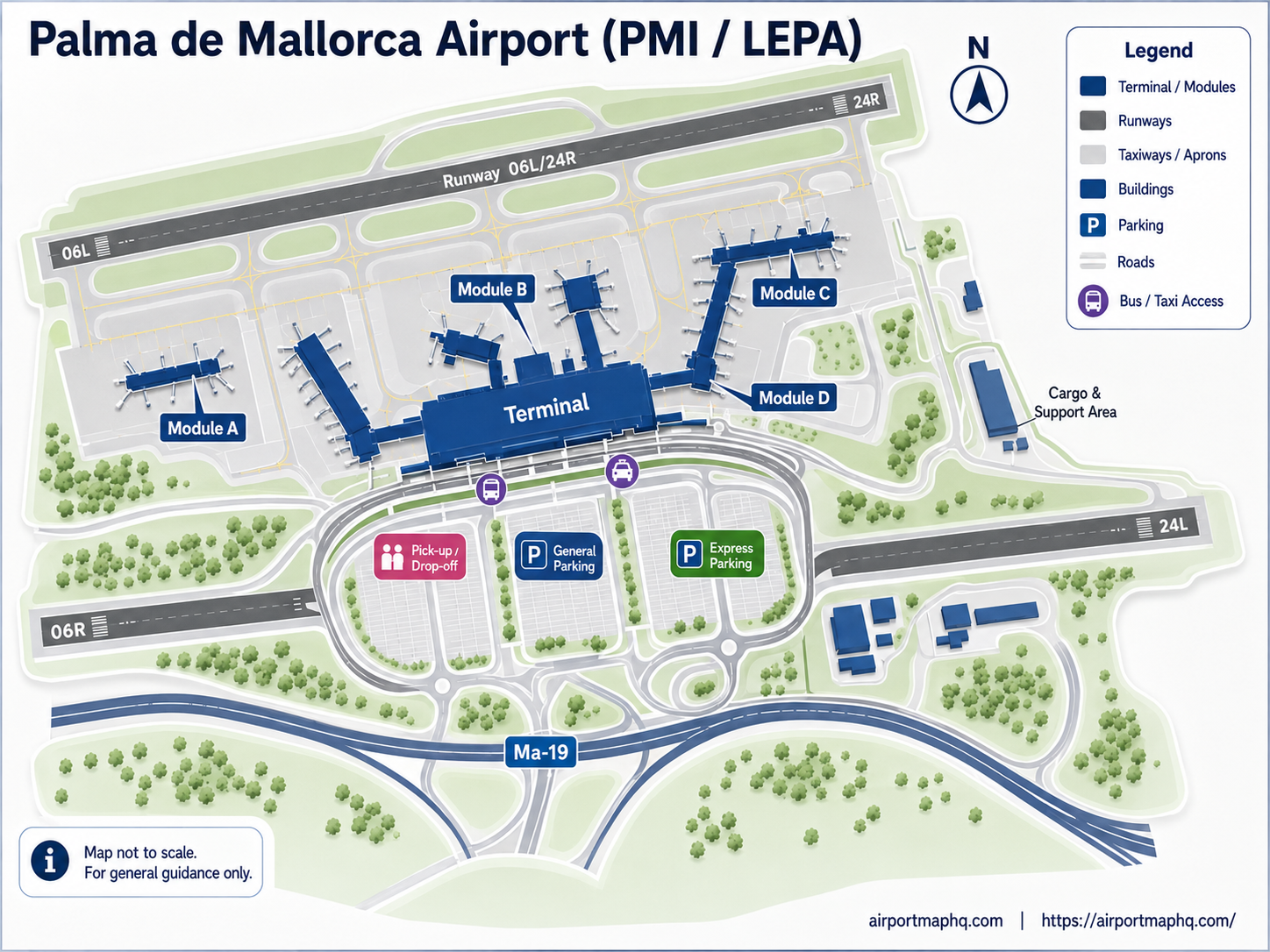
The Palma Airport map below shows the full layout of Palma de Mallorca Airport (PMI/LEPA), also known as Son Sant Joan Airport. PMI handled 33.3 million passengers in 2024, making it the third busiest airport in Spain after Madrid Barajas and Barcelona El Prat, and one of the fourteen busiest in Europe. It is the main base for Air Europa and a major operating focus for Eurowings, EasyJet, Jet2, Ryanair and Vueling, with 65+ airlines serving 175+ destinations across Europe and beyond.
As the Palma Airport map shows, PMI consists of a single central terminal building connected to four boarding modules arranged around it: Module A to the north, Module B to the north-east, Module C to the east and Module D to the south. There are no inter-module trains or shuttles airside; after clearing security on level 2 you walk to your module. Module C is the furthest from security and can take up to 10 minutes on foot. Study the PMI airport map before you travel so you know which module your airline uses.
 Click image to view full size
Palma Airport Location Map
Palma de Mallorca Airport sits 8 km (5 miles) east of Palma city centre, adjacent to the village of Can Pastilla on the Bay of Palma. The airport shares its two runways with the Spanish Air Force’s Son Sant Joan Air Base. Road access is via the Ma-19 motorway, which runs along the southern coast and connects the airport directly to central Palma and the major resort towns of Arenal, Magaluf and Santa Ponsa.
Interactive map showing Palma Airport’s location east of Palma city centre on the Bay of Palma
View Larger Map
Palma Airport Terminal Layout
PMI has a single terminal building with six floors accessible to passengers. Levels 0 and 2 are arrivals and check-in. Level 4 is a secondary departures hall. After passing through security on level 2, you move airside into one of the four boarding modules. Each module is a separate structure connected to the terminal building by a covered walkway or bridge, but there is no airside train or people mover between them. All four modules share the same security zone, so there is no need to re-screen when walking between modules once airside.
Palma Airport Module A
Module A is located to the north of the main terminal building and is identified throughout by blue signage. It is the only module at PMI equipped with double airbridges, allowing faster passenger boarding and deplaning. Module A handles all non-Schengen flights departing from Palma, which means destinations in the UK, Ireland and other countries outside the Schengen Area. During the winter off-season, Module A may operate on a reduced schedule or close temporarily.
Module A is the only module with double airbridges at PMI. 8 of its 28 gates have airbridge access; the rest use stairs or buses. It processes customs and immigration for non-EU arrivals. Airside area is on the ground floor.
Palma Airport Module B
Module B sits to the north-east of the main terminal and is marked throughout by green signage. It is the smallest of the four modules, with just 8 gates, and none of them have airbridges, meaning all boarding is via stairs or buses on the tarmac. Module B is used exclusively by Air Nostrum, the Iberia regional franchise that operates propeller and small jet aircraft on short routes to Menorca, Ibiza, Valencia, Lleida, Asturias and Santiago de Compostela.
Module B is the quickest to reach from security and is used only for inter-island and short mainland Spanish routes. All 8 gates are bus-boarding with no airbridges. The Sala VIP Valldemossa lounge is located on the first level of this module.
Palma Airport Module C
Module C is the largest module at PMI and is located to the east of the main terminal, identified by purple signage. It handles Schengen-zone flights including the majority of routes to Germany, France, the Netherlands, Scandinavia and other EU countries. Eurowings and Condor use Module C as their primary base at Palma, alongside EasyJet and Norwegian Air Shuttle on Schengen routes. Module C is the longest walk from security, so allow 10 minutes after clearing the checkpoint. Odd-numbered gates in this module are reached by bus transfer on the tarmac.
Module C gates are on the first floor. 9 of 33 gates have airbridges; all odd-numbered gates use bus transfers. This is the furthest module from the security checkpoint, so allow extra time after clearing security. The Sala VIP Mediterraneo lounge is airside within this module.
Palma Airport Module D
Module D is located to the south of the terminal building and uses orange signage throughout. It handles a mix of Schengen and domestic flights. The module has two levels, both dedicated to the boarding area. Module D was closed on 4 November 2025 for roof renovation and interior refurbishment as part of the wider €560 million airport upgrade. During the closure, flights that would normally use Module D were relocated to Module C. Module D is planned to reopen in April 2026 with improved facilities, additional airbridges and a wider concourse.
Module D was closed from 4 November 2025 and is expected to reopen in April 2026. The renovation is adding airbridges to additional gates and enlarging the module interior. Odd-numbered gates historically used bus transfers. Access is from level 2 of the main terminal after passport control where required.
Palma Airport Security
Security filters at Palma Airport are located on level 2 of the main terminal, directly behind the check-in counters. There is a single security area serving all four modules. Once through, you remain in the common airside zone and can walk freely between modules without being re-screened. A Fast Track lane is available for business passengers and those with priority tickets. Separate passport control points are positioned within Module A (for non-Schengen departures) and near Module D (where required by destination).
Getting to Palma Airport
There is no train or metro line directly serving Palma Airport. The options are bus, taxi, private transfer and car. A new central bus station opened at the airport in August 2025, consolidating all departure and arrival bus stops in one location outside the terminal. All buses returning to the airport drop passengers off outside the departures hall on the upper level.
Palma Airport Parking
A five-level multi-storey car park with approximately 6,000 spaces sits directly opposite the terminal building. Pre-book parking online via aena.es for the best rates, particularly during peak summer months when the car park fills quickly. A new elevated walkway with travellators connecting the car park to the arrivals and departures levels opened in early 2026, replacing the previous at-grade crossing that caused congestion during busy periods.
Palma Airport Lounges
PMI has four passenger lounges, all bookable in advance regardless of your airline or ticket class. The Sala VIP Valldemossa is the newest and largest, located in Module B. The Sala VIP Mediterraneo is airside in Module C. The Sala VIP Formentor is on the departures level 4 in the main terminal. The Sala VIP Llevant is in the main terminal and open from 5 a.m. to midnight. All lounges offer Wi-Fi, snacks, hot and cold drinks and seating. Check each lounge’s access terms when booking, as some are airside (post-security) and some are landside.
Palma Airport Arrivals
Passengers arriving on Schengen flights deplane at their module, walk through to the main terminal and collect bags at the baggage carousels on level 0. Carousels 8 and 9 are reserved for non-Schengen and non-EU arrivals. Non-EU passengers arriving in Module A clear passport control before entering the baggage claim hall. Ground transport (taxis, buses, car rental) is all accessed from level 0 outside the arrivals exit.
Meeting Arriving Passengers
Meeting points are on the arrivals level (level 0) outside the baggage hall exits. Check the flight arrivals screens in the terminal for carousel allocation and any delays. Parking for pick-up is in the terminal car park (P1) with a short free period; the new elevated walkway makes the walk between car park and arrivals much easier than before.
Palma Airport Departures
Check-in opens approximately 2.5 to 3 hours before departure for international flights and 2 hours before domestic flights. The 204 check-in counters are spread across 6 zones on level 2. Self check-in kiosks are available for Air Europa. Bag drop counters are near each check-in zone. Once checked in, proceed to security on level 2, then follow the coloured signs to your module (blue for A, green for B, purple for C, orange for D).
Recommended Arrival Times
Arrive at least 2 hours before domestic and Schengen flights. Allow 2.5 to 3 hours before non-Schengen international departures (Module A), which require passport control in addition to security. During peak summer season (July and August) queues at security and check-in can be substantial, so lean towards 3 hours for any flight. Module C, the largest, is the longest walk from security and can take up to 10 minutes once airside.
Insider Tips
PMI is a summer-peaking airport: roughly 80% of its annual passengers travel between May and October. In July and August, the airport operates close to or beyond its design capacity of 25 million passengers per year, so early morning flights are significantly calmer. The new central bus station (open since August 2025) makes catching a bus to Palma city centre straightforward and removes the confusion of scattered stops. Module C is the longest walk from security and also where most of the larger Schengen carriers operate, so if your airline uses C, factor in extra time. Module D is expected to reopen in April 2026 with improved airbridges and larger facilities. Check the Palma Airport map above to identify your module before you reach the terminal.
Palma Airport Map — FAQ
How many terminals does Palma Airport have?
One main terminal building divided into four boarding modules: A (north, blue), B (north-east, green), C (east, purple) and D (south, orange). Module D was closed from November 2025 for renovation and is expected to reopen in April 2026.
Which airlines fly from which module at Palma Airport?
Module A handles non-Schengen routes to the UK and Ireland: Ryanair, Jet2, TUI, British Airways. Module B is Air Nostrum only, for regional hops to Menorca, Ibiza and mainland Spain. Module C is the largest and serves Eurowings, Condor, easyJet, Norwegian and other Schengen destinations. Module D (when open) handles a mix of Schengen and domestic flights including some Ryanair, Iberia and Vueling services.
Is there a train to Palma Airport?
No direct rail or metro line serves PMI. Take the EMT A1 bus to Placa Espanya in Palma (~30 min), where you can connect to the SFM train network. Taxis take about 15 minutes to the city centre.
How far is Palma Airport from Palma city centre?
About 8 km (5 miles) east. Taxi: ~15 min, around €28–37. Bus A1: ~30 min.
What is the renovation work at Palma Airport in 2026?
A €560 million overhaul of the entire airport, the biggest since 1997. Key work includes Module D roof and interior renovation (closed November 2025, reopening April 2026), new elevated walkway with travellators between the terminal and car park, additional airbridges in Modules A and D, and a new central bus station (open since August 2025). All major works are expected to finish by end of 2026.
Where is security at Palma Airport?
Level 2 of the main terminal, behind the check-in counters. One security zone serves all four modules. A Fast Track lane is available for priority passengers. After clearing security, all modules are accessible without re-screening.
Where can I find parking at Palma Airport?
A 5-level car park with ~6,000 spaces is directly opposite the terminal. A new elevated walkway links it to arrivals and departures. Pre-book at aena.es for lower rates, especially in summer.
What does the Palma Airport map show?
The Palma Airport map shows the main terminal building, the four modules (A, B, C, D) and their positions, the two runways shared with Son Sant Joan Air Force Base, the multi-storey car park, the central bus station, taxi rank, car rental area and road access from the Ma-19 motorway.
Can I walk between modules at Palma Airport?
Yes. Once airside after security, all four modules are connected on foot within the secure zone. No re-screening is needed. Module C is the furthest from security, with a walk of up to 10 minutes.