Paris CDG Airport Map & Terminal Guide 2026
Three terminals, nine sub-terminals, 105 airlines. Everything you need to navigate Paris Charles de Gaulle Airport (CDG) before the terminal renaming lands in March 2027.
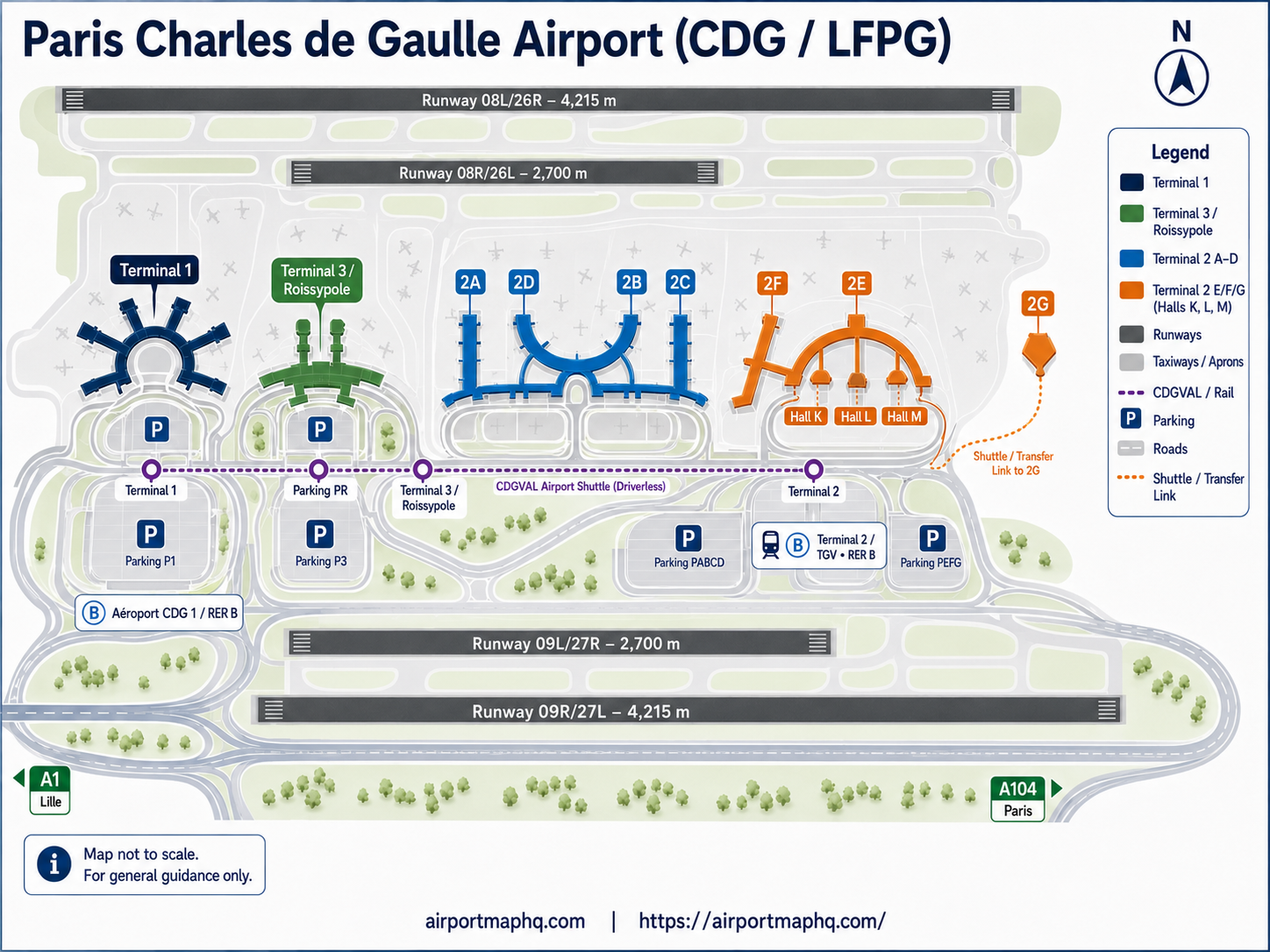
Paris CDG Airport Map
The Paris CDG airport map below shows the full layout of Paris Charles de Gaulle Airport (CDG/LFPG), the largest and busiest airport in France and the primary hub for Air France. CDG handled 70.3 million passengers in 2024, ranking it the busiest airport within the European Union and the third busiest in Europe. As of 2025, it is served by more than 105 airlines connecting passengers to over 245 destinations worldwide.
The CDG airport map covers all three terminal buildings: Terminal 1 (the original circular building), Terminal 2 (a two-kilometre complex split into sub-terminals 2A through 2G), and Terminal 3 (the low-cost terminal opposite Terminal 1). The free CDGVAL automated shuttle links all three terminals. Study the Paris CDG map before you travel so you arrive at the right terminal, as the wrong one can cost you significant time.
 Click image to view full size
Paris CDG Airport Location Map
Paris Charles de Gaulle Airport is located in Roissy-en-France, approximately 25 km northeast of central Paris. The airport sits near the A1 and A3 motorways, giving straightforward road access from the city and from northern France. The RER B train runs directly from the Terminal 2 station to central Paris.
CDG Airport Terminals Overview
CDG has three terminal buildings, each serving distinct groups of airlines. Terminal 1, the oldest, handles Star Alliance carriers and a number of non-aligned international airlines. Terminal 2 is the largest facility on the site, stretching roughly two kilometres and split into seven sub-terminals (2A through 2G) that serve Air France, SkyTeam partners, and a range of other carriers. Terminal 3 is the low-cost terminal, hosting charter and budget airlines and rated the world's best low-cost terminal by Skytrax in 2024. Because each terminal handles entirely different airline groups, checking your terminal before you arrive is critical at CDG.
CDG Terminal 1
Terminal 1 is the original Charles de Gaulle terminal, opened in 1974 and designed by architect Paul Andreu. Its circular "octopus" layout houses check-in and services in a central building, with seven satellite buildings connected by underground walkways and moving walkways on the airside. Terminal 1 has five floors: the ground level is not open to the public, Level 2 holds the CDGVAL station and some check-in, Level 3 holds departures and ticketing, Level 4 is the airside boarding floor, and Level 5 is arrivals and baggage claim. Terminal 1 primarily serves Star Alliance airlines, with a number of Oneworld and non-aligned carriers also operating here.
Terminal 1 is served by the CDGVAL light-rail shuttle and has its own dedicated taxi and bus stops. RER B and TGV access is via the Terminal 2 station: take the CDGVAL across.
CDG Terminal 2
Terminal 2 is the centrepiece of CDG, spanning roughly two kilometres and divided into seven sub-terminals: 2A, 2B, 2C, 2D, 2E, 2F and 2G. Sub-terminals 2A through 2F are connected by pedestrian walkways and are all part of the same building complex. Terminal 2G is a completely separate satellite building 800 m away, accessible only by a free shuttle bus. Terminal 2 also contains the RER B suburban rail station, the TGV high-speed rail station and the airport hotel Yotel Paris Charles de Gaulle (T2E, accessible only to passengers with a non-Schengen boarding pass).
Air France uses sub-terminals 2E, 2F and 2G as its main operating base. SkyTeam partner airlines including Delta Air Lines and KLM also operate from Terminal 2. Some Oneworld carriers such as Japan Airlines and Air Canada are also based here.
Terminal 2B reopened after a significant renovation period. easyJet has established a base here for its Paris CDG routes to European and North African destinations.
2C (non-Schengen) and 2D (Schengen) share the same layout across two floors, with arrivals on the lower level and departures above. Both are connected by walkways to the rest of the Terminal 2 complex.
Terminal 2E is the largest section of CDG, serving international non-Schengen flights. Boarding Areas L (Satellite S3) and M (Satellite S4) are accessible only via the internal LISA airside transit train, available after passing security. Allow extra time if your gate is in Hall L or M.
Terminal 2F handles Air France European and Schengen routes. Shuttle bus N2 departs from Terminal 2F and provides the only connection to Terminal 2G.
Terminal 2G sits 800 m from the main Terminal 2 complex and is the only sub-terminal not connected by a walkway. Reach it via free shuttle bus N2 from Terminal 2F. N2 also departs from Terminal 2E after 21:30. Allow at least 20 minutes from the main Terminal 2 building.
CDG Terminal 3
Terminal 3 is CDG's dedicated low-cost and charter terminal, located directly opposite Terminal 1 about 1 km away. It handles airlines such as Vueling, Air Transat, SunExpress, Norse Atlantic Airways and other charter carriers. Unlike every other terminal at CDG, Terminal 3 has no jet bridges or boarding gates: all passengers board by walking across the apron or taking a bus to the aircraft. Terminal 3 was rated the world's best low-cost terminal by Skytrax in 2024. It is a single building divided into a departures zone (south side, with Hall A and Hall B) and an arrivals zone (north side).
Terminal 3 is linked to Terminals 1 and 2 by the CDGVAL shuttle. Skytrax awarded it the title of world’s best low-cost terminal in 2024, recognising recent improvements to its facilities and passenger flow.
Getting Between Terminals at CDG
The free CDGVAL automated light-rail shuttle is the main link between Terminal 1, Terminal 2 and Terminal 3. It runs from 04:00 to 01:00 daily, with departures every four to five minutes. The full journey between Terminal 1 and Terminal 2 takes around eight minutes. Within Terminal 2, sub-terminals 2A through 2F are connected by pedestrian walkways and can be navigated on foot, though the distances are significant. Two free shuttle bus lines supplement the walkways: Line N1 links 2A, 2C, 2D, 2E and 2F, departing every seven to eight minutes. Line N2 connects 2F with 2G, and also departs from 2E after 21:30.
Minimum Connection Times at CDG
CDG is a large, complex airport with long walking distances and passport control to factor in. As a rule, allow a minimum of 45 to 60 minutes for connections within the same terminal on Schengen flights, 75 minutes for non-Schengen connections within the same terminal, and at least 90 to 120 minutes when changing terminals, particularly when moving between Terminal 1 and Terminal 2 or travelling to Terminal 2G. Air France recommends a minimum connecting time of 60 minutes for intra-terminal connections and 90 minutes when terminals differ. For non-EU passport holders who need to clear passport control, add another 20 to 30 minutes during busy periods.
CDG Airport Security Checkpoints
Each terminal at CDG has its own dedicated security checkpoints. Passengers cannot move between terminals airside after clearing security. If you need to change terminals at CDG, you must exit the secure zone, take the CDGVAL or a shuttle bus to the correct terminal, and clear security again. Fast Track lanes are available at security checkpoints across all terminals for passengers in Business Class, First Class or with elite frequent-flyer status. Present your boarding pass to access the Fast Track lane. Passport control for non-Schengen arrivals is located in each terminal and is clearly signposted.
Getting to Paris from CDG Airport
All transport options leave from the arrivals level of each terminal. The RER B station is located inside Terminal 2 (follow signs for “Train Paris”). Passengers from Terminals 1 and 3 take the CDGVAL to reach the RER B station.
CDG Airport Parking
Each terminal at CDG has its own dedicated parking areas. Pre-booking online at the Paris Aéroport website is strongly recommended, particularly during summer and school holidays. Covered short-stay car parks sit directly adjacent to Terminals 1, 2 and 3, while economy outdoor lots offer lower daily rates at a short walk or shuttle ride away.
CDG Airport Map: Arrivals
Arrivals procedures differ depending on whether your flight is a Schengen or non-Schengen (international) arrival. Schengen passengers from EU and associated countries pass directly to baggage claim without going through passport control. Non-Schengen passengers follow signs for passport control, which is located in each terminal and clearly marked. After collecting bags, ground transportation, taxis, the CDGVAL and bus services are all signposted from the arrivals halls at each terminal.
CDG Airport Map: Departures
Confirm your terminal and sub-terminal before you leave for the airport. For Air France and SkyTeam flights, go to Terminal 2 and check which sub-terminal (2A through 2G) is printed on your booking. For most Star Alliance airlines, go to Terminal 1. For low-cost and charter flights, go to Terminal 3. Check in at the counters on the departures level, clear security, and follow signs to your gate. Gates in Terminal 2E Halls L and M require an additional airside transit (the LISA shuttle train), so allow extra time if your gate is in those areas.
Recommended Arrival Times
Arrive at least two hours before a short-haul Schengen flight and three hours before any long-haul international departure. During peak morning hours and holiday periods, an extra 30 minutes is wise, particularly for Terminal 2E. Check-in desks typically close 45 to 60 minutes before departure.
CDG Airport Insider Tips
Always confirm your sub-terminal (2A, 2B, 2C, 2D, 2E, 2F or 2G) for Terminal 2 flights, not just the terminal number. The complex is over two kilometres long, and ending up at the wrong sub-terminal can be a stressful scramble. If your gate is in Terminal 2E Hall L or M, add at least 15 extra minutes after security for the internal LISA transit train. The RER B (€14 flat fare from January 2025) is the quickest budget route into Paris; buy a ticket at the machine in the Terminal 2 rail hall. Terminal 1 passengers need the CDGVAL to reach the RER B station. The CDGVAL runs from 04:00 to 01:00 only, so late-night arrivals after 01:00 must use a taxi or pre-booked transfer. Check your boarding pass carefully when the terminal renaming lands in March 2027.
Paris CDG Airport Map: FAQ
How many terminals does Paris CDG airport have?
CDG has three terminal buildings: Terminal 1, Terminal 2 and Terminal 3. Terminal 2 is subdivided into seven sub-terminals (2A through 2G). Sub-terminals 2A through 2F are connected by pedestrian walkways. Terminal 2G is a separate satellite building reached only by a free shuttle bus.
Which terminal is Air France at CDG?
Air France primarily operates from Terminal 2, using sub-terminals 2E (long-haul non-Schengen), 2F (European Schengen routes) and 2G (Air France Hop regional flights via satellite shuttle bus).
What airlines fly from Terminal 1 at CDG?
Terminal 1 serves mainly Star Alliance carriers including Lufthansa, United Airlines, Turkish Airlines, Swiss and ANA. Oneworld airlines such as Cathay Pacific, Qatar Airways and Oman Air also use Terminal 1, along with non-aligned carriers including Emirates, Etihad Airways, Aer Lingus, Eurowings and Icelandair.
How do I get between terminals at CDG airport?
The free CDGVAL automated light-rail shuttle connects Terminal 1, Terminal 2 and Terminal 3 every four to five minutes (04:00 to 01:00 daily). Within Terminal 2, sub-terminals 2A through 2F are walkable. Free shuttle bus N1 links 2A, 2C, 2D, 2E and 2F. Shuttle bus N2 connects 2F with 2G. You cannot move between terminals airside: you must exit security, transfer, and re-clear at the new terminal.
How do I get from CDG to Paris city centre?
The RER B train costs €14 (flat fare from January 2025) and takes around 25 minutes to Gare du Nord or 35 to 40 minutes to Châtelet-Les Halles. Official taxi fares are fixed at €56 to the Right Bank and €65 to the Left Bank. The CDG Express non-stop direct train to Gare de l’Est opens in early 2027.
What airlines fly from Terminal 3 at CDG?
Terminal 3 handles low-cost and charter airlines including Vueling, Air Transat, SunExpress, Norse Atlantic Airways and others. There are no jet bridges: all passengers board via buses. Terminal 3 was rated the world’s best low-cost terminal by Skytrax in 2024.
Is CDG airport changing its terminal names?
Yes. Groupe ADP announced in December 2025 that CDG terminals will be fully renumbered from March 2027. Terminals will be numbered 1 through 7. Terminal 1 keeps its name. The current Terminal 3 becomes Terminal 2. The current Terminal 2 complex becomes Terminals 3 through 7. Until March 2027, the current numbering and lettering system is still in use.
Where is parking at CDG airport?
Covered parking is available at each terminal. P1 serves Terminal 1, and P2 covers the Terminal 2 complex with multiple decks across sub-terminals. Economy outdoor lots offer lower daily rates with a free shuttle. Covered spaces start from around €30 per day. Pre-book online at the Paris Aéroport website for the best rates.
What does the Paris CDG airport map show?
The Paris CDG airport map shows all three terminal buildings (Terminal 1, Terminal 2 with sub-terminals 2A through 2G, and Terminal 3), the CDGVAL light-rail shuttle route, pedestrian walkway connections within Terminal 2, the RER B and TGV rail station inside Terminal 2, parking facilities, inter-terminal shuttle bus routes N1 and N2, and road access via the A1 and A3 motorways.
Can I walk between terminals at CDG?
You can walk between sub-terminals 2A through 2F within the Terminal 2 complex via internal pedestrian walkways, but the distances are significant (the complex stretches over two kilometres). You cannot walk between Terminal 1, Terminal 2 and Terminal 3 airside. Use the free CDGVAL shuttle or shuttle buses. Terminal 2G can only be reached by shuttle bus, not on foot.