Phoenix Airport Map & Terminal Guide 2026
Two terminals, 119 gates, one free Sky Train. Everything you need to navigate Phoenix Sky Harbor International Airport (PHX) — Terminal 3, Terminal 4, concourses, security, parking and transport.
Phoenix Airport Map
The Phoenix Airport map below shows the full layout of Phoenix Sky Harbor International Airport (PHX/KPHX) — nicknamed “America’s Friendliest Airport.” PHX set a new passenger record of over 52 million travellers in 2024, ranking as the 11th-busiest airport in the United States. It is the primary hub for American Airlines, a Southwest Airlines base, and a domestic focus city for Frontier Airlines, with service to over 200 destinations across North America and beyond.
As you can see on the Phoenix Airport map, the layout centres on two active terminals connected by the free, automated PHX Sky Train: Terminal 3 (John McCain Terminal) to the west and Terminal 4 (Barry M. Goldwater Terminal) to the east. Both terminals share security, dining and ground transport infrastructure, but use separate check-in counters and concourses. Study the PHX airport map before you travel so you know which terminal and concourse your airline uses.
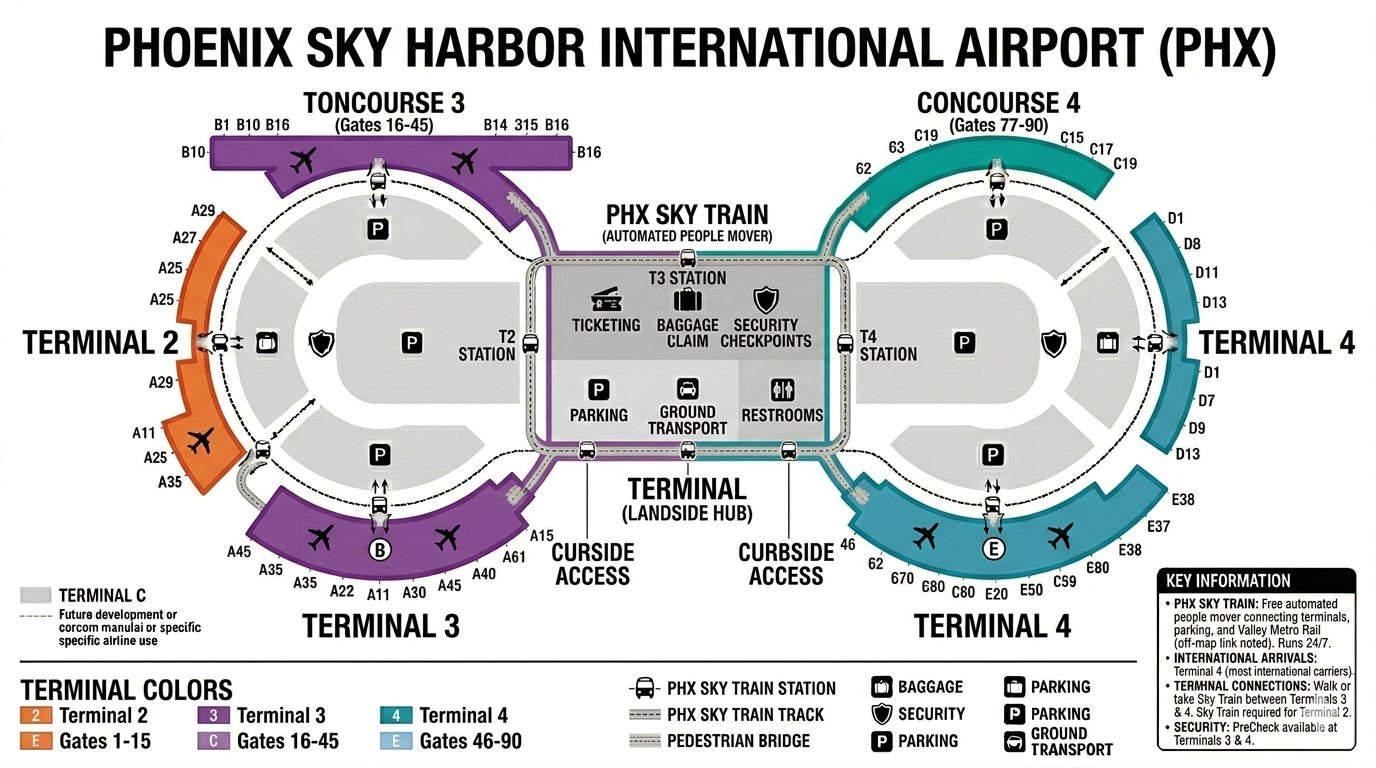 Click image to view full size
Phoenix Airport Location Map
Phoenix Sky Harbor International Airport sits just 3 miles (4.8 km) east of downtown Phoenix, making it one of the most city-central major airports in the United States. The airport is accessed via Sky Harbor Boulevard, with direct connections to Interstate 10 (linking downtown Phoenix, Tempe and Tucson) and Interstate 17 (north to Flagstaff). The 44th Street PHX Sky Train station connects directly to Valley Metro Rail for carfree travel to central Phoenix, Tempe and Mesa.
Interactive map showing Phoenix Sky Harbor Airport’s location east of downtown Phoenix
View Larger Map
Phoenix Airport Terminals Overview
Phoenix Sky Harbor has two active terminals, both served by the same free PHX Sky Train. Terminals 1 and 2 have been retired — Terminal 2 was demolished in 2021 and its airlines relocated to Terminal 3. The two active terminals use different numbering systems for their gates: Terminal 3 uses E and F gate designations, while Terminal 4 uses lettered concourses A through D with corresponding gate numbers.
Terminal 3 — John McCain Terminal
Terminal 3, officially the John McCain Terminal, is the smaller of PHX’s two active terminals. Renovated and expanded in 2020, it handles a growing share of the airport’s traffic, particularly for Delta, United and Frontier. Terminal 3 is generally less crowded than Terminal 4 and is known for faster security wait times.
The F gates are connected to the main lobby via a pedestrian walkway. The PHX Sky Train station sits on the west side of the terminal, connecting to Terminal 4, economy parking and Valley Metro Rail.
Terminal 4 — Barry M. Goldwater Terminal
Terminal 4, officially the Barry M. Goldwater Terminal, is by far the largest and busiest at PHX, handling more than 80% of the airport’s passengers. It has 92 gates spread across eight concourses designated A through D (with north and south subdivisions). All concourses in Terminal 4 are connected airside, so travellers can walk between any A, B, C or D gate after clearing security without needing to re-clear TSA. Terminal 4 is American Airlines’ sixth-largest hub and Southwest Airlines’ largest station.
Phoenix Airport Security Checkpoints
Terminal 3 has one security checkpoint on Level 4 (the departures level). Terminal 4 has multiple checkpoints on Level 3, one for each concourse letter — Checkpoint A serves A gates, Checkpoint B serves B gates, and so on. Use the checkpoint matching your concourse to minimise walking after security. TSA PreCheck and CLEAR lanes are available at both terminals.
PHX Sky Train — Getting Between Terminals
The PHX Sky Train is the backbone of Phoenix Airport’s inter-terminal transport. It is a free, fully automated people-mover running 24 hours a day with no fare required. The Sky Train connects Terminal 3, Terminal 4, East Economy Parking, the 44th Street/Washington Valley Metro Rail station (for light rail connections into Phoenix, Tempe and Mesa), the 24th Street parking station, and the Rental Car Center.
Between terminals, the journey takes approximately 2–4 minutes. During daytime hours (5 a.m.–10 p.m.) trains run every 3–5 minutes. Overnight (10 p.m.–5 a.m.) service continues but frequency may be reduced to 15 minutes or more due to maintenance windows. The train features a remarkable 100-foot-tall bridge over an active taxiway — the first transit bridge in the world built over a taxiway.
Getting to Phoenix Airport
All public transport arrives at the terminal-level ground transportation areas and at the 44th Street PHX Sky Train station, which connects directly to Valley Metro Rail.
Phoenix Airport Parking
PHX has over 30,000 on-site parking spaces. Pre-book at skyharbor.com for discounted rates and guaranteed availability.
Phoenix Airport Map — Arrivals
Arriving passengers land at the concourse used by their airline (E/F in Terminal 3, or A–D in Terminal 4), and then walk or take the terminal’s internal people mover to the arrivals level. In Terminal 3, arrivals exit to Level 3. In Terminal 4, arrivals exit to Level 1. International arrivals clear U.S. Customs and Border Protection in the Terminal 4 D gates area before accessing baggage claim.
Ground Transportation from Arrivals
Baggage claim is at the arrivals level of whichever terminal you land in. After collecting bags, follow signs to taxis, rideshares (dedicated curbside islands), Valley Metro Rail (via the PHX Sky Train to 44th Street) and rental cars (PHX Sky Train to Rental Car Center). If someone is picking you up by car, direct them to the free cell phone waiting lots and ask them to collect you from the arrivals curbside once you have your bags.
Phoenix Airport Map — Departures
Departing passengers should confirm which terminal their airline uses before arriving — Terminal 3 for Alaska, Delta, Frontier, Hawaiian and United; Terminal 4 for American, Southwest and international carriers. Enter the terminal at the departures level (Level 4 in Terminal 3; Level 3 in Terminal 4), check in at your airline’s counter, then clear the security checkpoint closest to your concourse. After security, all concourses within each terminal are connected airside. Use the PHX Sky Train for the inter-terminal transfer only if your itinerary requires it — you will not need to re-clear security when connecting between concourses inside Terminal 4.
Recommended Arrival Times
PHX recommends arriving at least two hours before domestic departures and three hours before international departures. Terminal 4 security can be significantly busier than Terminal 3, particularly during peak morning hours (4–8 a.m.) and mid-afternoon. Use the live security wait time tracker on the Sky Harbor website, or register with PHXRESERVE to book a security time slot and skip the general lane queue.
Construction & Future Expansion
Beyond the Terminal 3 north concourse, Sky Harbor has announced plans for a future third terminal further west on the airport property. The new terminal is expected to host American Airlines or Southwest Airlines flights, plus international carriers, as part of the airport’s 20-year Comprehensive Asset Management Plan. Planning for this major project is primarily taking place in 2026.
Insider Tips for Phoenix Sky Harbor
Confirm your terminal before you leave home — many travellers default to Terminal 4 only to find their flight is in Terminal 3. The PHX Sky Train makes a quick fix, but it costs time. Terminal 4 Checkpoints B and D are currently closed in 2026; use Checkpoints A or C for all T4 flights. Phoenix sits at 1,135 feet elevation with an extreme desert climate — in summer, parked cars in uncovered lots can reach dangerous temperatures; use the covered East Economy Garages if travelling from June through September. Morning departures generally face lighter road traffic than afternoon flights. For spring training (February–March) and major events like the Waste Management Phoenix Open, allow extra time as roads and lots fill quickly.
Phoenix Airport Map — FAQ
How many terminals does Phoenix Sky Harbor have?
Two active terminals: Terminal 3 (John McCain Terminal, 27 gates) and Terminal 4 (Barry M. Goldwater Terminal, 92 gates). Terminals 1 and 2 have been retired. The free PHX Sky Train connects both terminals 24/7.
Which airlines fly from Terminal 3?
Alaska Airlines, Delta Air Lines, Frontier Airlines, Hawaiian Airlines and United Airlines. Gates are numbered E1–E10 and F1–F15.
Which airlines fly from Terminal 4?
American Airlines (Concourses A and B, gates A1–A30 and B1–B28), Southwest Airlines (Concourses C and D, gates C1–C19 and D1–D18), plus international carriers including British Airways, WestJet, Volaris and Condor.
How do I get between Terminal 3 and Terminal 4?
The free PHX Sky Train runs every 3–5 minutes, 24/7. The trip between terminals takes 2–4 minutes. No re-screening is required when connecting between T3 and T4 if you remain in the secure airside area.
Where is security at Phoenix Airport?
Terminal 3: one checkpoint on Level 4. Terminal 4: Checkpoints A and C (B and D currently closed in 2026), Level 3. All T4 concourses are connected airside after any checkpoint. TSA PreCheck and CLEAR at both terminals.
How far is Phoenix Airport from downtown?
3 miles east. Valley Metro Rail: ~20 min ($2 fare). Rideshare: 10–20 min, ~$15–$25.
Where can I park at Phoenix Sky Harbor?
Terminal garages (closest, $30/day max), East Economy Garages A & B ($16/day, Sky Train access), East Economy Lot Uncovered ($14/day), West Economy Park & Walk ($9/day, no shuttle). Pre-book at skyharbor.com.
What does the Phoenix Airport map show?
The Phoenix Airport map shows Terminal 3 and Terminal 4 with all concourses and gate numbers, the PHX Sky Train route, East Economy Parking, the 44th Street Valley Metro Rail connection, the Rental Car Center, cell phone lots and Sky Harbor Boulevard access roads.
Can I walk between Terminal 3 and Terminal 4?
Not directly on foot through the secure area. Use the PHX Sky Train (free, 2–4 min). A pedestrian walkway connection between the terminals is being built as part of the new Terminal 3 north concourse, expected to open in 2027.