Rome Fiumicino Airport Map & Terminal Guide 2026
Two terminals, 144 gates, over 51 million passengers a year. Everything you need to navigate Leonardo da Vinci–Fiumicino Airport (FCO) — Italy’s busiest airport and the primary international gateway to Rome.
Rome Fiumicino Airport Map
The Rome Fiumicino Airport map below covers the full layout of Leonardo da Vinci–Fiumicino International Airport (FCO/LIRF). FCO handled over 51 million passengers in 2025, passing that threshold for the first time and confirming its place as Italy’s busiest airport, the eighth busiest in Europe, and the 39th busiest in the world. Ranked 7th at the 2026 World Airport Awards, the airport serves Rome, Vatican City, and the wider Lazio region and connects to more than 230 destinations across six continents with over 90 airlines.
As the Rome Fiumicino Airport map shows, the layout is straightforward: Terminal 1 on one side for domestic and Schengen traffic, and Terminal 3 on the other handling all remaining international routes. The two buildings are connected airside with no need to re-clear security for most connection types. Study the FCO map before you travel so you arrive at the right terminal and know where your gate is.
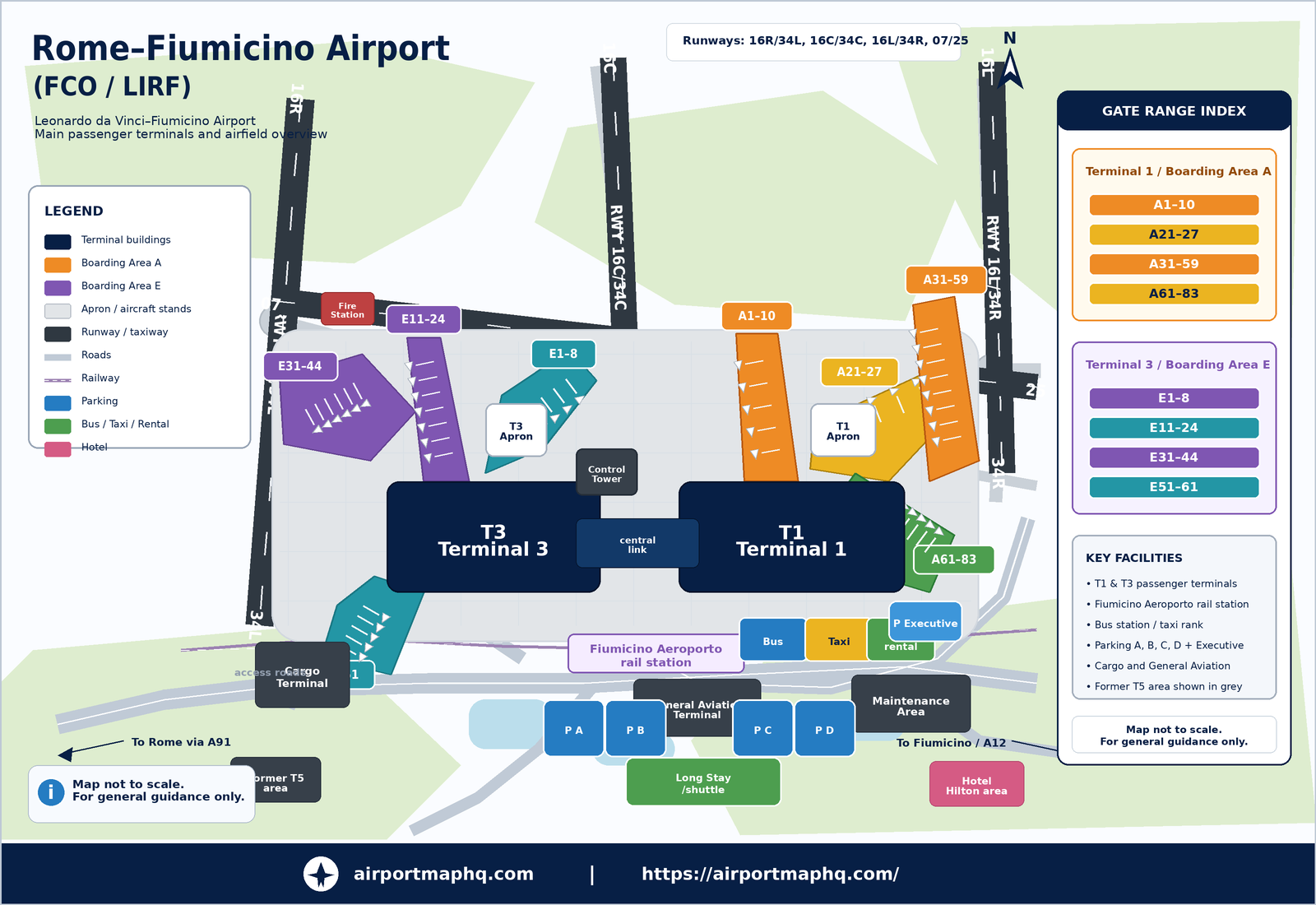 Click image to view full size
Rome Fiumicino Airport Location Map
Leonardo da Vinci–Fiumicino Airport sits approximately 30 km (19 miles) southwest of Rome city centre, in the municipality of Fiumicino. The airport location map below shows FCO’s position relative to central Rome. Road access is via the A91 motorway (Roma–Fiumicino), which connects to Rome’s ring road (Grande Raccordo Anulare). The airport has its own train station with direct rail links into central Rome.
Rome Fiumicino Airport Terminals
FCO operates two active terminals: Terminal 1 and Terminal 3. Terminal 2 was demolished in 2017 to allow Terminal 1 to expand, and the former Terminal 5 satellite building has been absorbed into Terminal 3. Each terminal has its own external curbside for arrivals and departures, its own check-in hall, security, and baggage claim. Airside, the two terminals are connected by a pedestrian walkway that takes roughly 7 to 8 minutes to walk.
Rome Fiumicino Terminal 1
Terminal 1 handles all domestic and Schengen zone flights. It is the home base for ITA Airways, Italy’s national carrier, and hosts a large number of European airlines. Gates run from A1 to A83, spread across a ground floor arrivals hall, a first floor departures area with boarding gates, shops and restaurants, and a mezzanine level with additional dining and the Primeclass Lounge.
Terminal 1 is generally less crowded than T3. Security lines tend to move quickly. E-gates are available for EU passport holders. The mezzanine level on the second floor is a good spot to find a seat and decent coffee before boarding.
Rome Fiumicino Terminal 3
Terminal 3 is FCO’s largest and busiest terminal, handling non-Schengen and intercontinental traffic. Gates run from E1 to E61. The terminal includes an airy central departures hall with an open shopping street concept known as Area E, multiple restaurant floors, and a pharmacy on the second floor. Non-Schengen departures at gates E31–E44 are reached via the SkyBridge people mover. Arriving international passengers clear Italian customs in the Terminal 3 arrivals hall; luggage storage is in the international arrivals area near carousel 14.
Terminal 3 is large and can get congested during peak hours. Allow extra time if your gate is in the satellite building (E31–E44) since the SkyBridge is one-way only. If you miss the train or need to return, you will have to re-clear security. The HelloSky Air Rooms & Lounge, open to all passengers for a fee, sits between T1 and T3 and is a good option for early departures or long layovers.
The SkyBridge — Non-Schengen Satellite Gates
The SkyBridge is an automated people mover (Innovia APM 100) connecting Terminal 3’s main building to the satellite gates E31–E44. These gates are used exclusively for non-Schengen departures, typically flights to the United States, Israel, and other destinations outside the Schengen Area.
Moving Between Terminals at Rome Fiumicino
Terminal 1 and Terminal 3 are connected airside by a pedestrian walkway. The walk takes around 7 to 8 minutes and there is no need to re-clear security if you remain in the transit zone. However, connection type matters:
Rome Fiumicino Airport Security
Both Terminal 1 and Terminal 3 have their own security checkpoints. Fast Track lanes are available in each terminal for passengers who have purchased a Fast Track pass or hold elite airline status. E-gates are available at FCO for EU passport holders, which speeds up immigration significantly. Passport control on arrival is required for passengers arriving from outside the Schengen Area before they exit into the arrivals hall.
Getting from Rome Fiumicino Airport to Rome
The airport train station is connected to both terminals by covered walkways with moving travelators — a walk of around 7 minutes from the terminal entrance. Ground transport for arrivals is on the ground floor of both terminals, directly outside the baggage claim exits. Official white taxis with the Rome city emblem on the doors are the only licensed cabs: use these and no others.
Rome Fiumicino Airport Parking
The official parking service at FCO is Easy Parking, operated by Aeroporti di Roma (ADR). Short-stay and long-stay car parks are connected to both terminals by covered walkways, so there is no outdoor exposure in bad weather. Pre-booking online is strongly recommended during summer and around Italian public holidays when availability is tight.
Rome Fiumicino Airport Map — Arrivals
Passengers arriving on domestic or Schengen flights deplane at their gate in T1 or T3, then proceed directly to baggage claim without passing through passport control. Arrivals from outside the Schengen Area land at Terminal 3, pass through Italian border control (passport check), collect bags, and exit via the international arrivals hall on the ground floor. Luggage storage is located in T3 international arrivals near carousel 14. Ground transport, taxis, buses, and the train station walkway are all on the ground floor after you exit the arrivals doors.
Rome Fiumicino Airport Map — Departures
Confirm your terminal before leaving for the airport: Terminal 1 for Schengen and domestic routes, Terminal 3 for most non-Schengen and long-haul flights. If you are departing to the USA, Israel, or another destination outside the Schengen Area from T3, your gate will likely be in the E31–E44 satellite building accessed via the SkyBridge. Check-in counters typically close 45 minutes before departure. Gate assignments appear on screens throughout both terminals and on your airline’s app.
Recommended Arrival Times at FCO
For Schengen and domestic flights, arrive at the airport at least 2 hours before departure. For non-Schengen and long-haul routes, allow at least 3 hours. During peak summer months (June to August) and around Easter and Italian national holidays, security can be slow in Terminal 3. Fast Track passes can be bought at the airport or in advance online and are worth it during busy periods.
Insider Tips for Navigating FCO
Confirm your terminal before you leave for the airport — the split between T1 and T3 trips up a lot of first-time visitors. If flying with ITA Airways you are almost always in Terminal 1. For flights to the US or Israel with non-European carriers, expect to end up in the T3 satellite gates via SkyBridge. Food inside the airport is expensive (a sandwich rarely costs less than €7) so eat in town before you travel if budget is a concern. The HelloSky Air Rooms & Lounge between the terminals is open to all passengers for a fee and a solid option for early departures or long layovers. The Leonardo Express is the fastest and most stress-free way into Rome if your hotel is anywhere near Termini — pay online and go straight to the platform. Do not take taxis from anyone who approaches you inside the terminal; only use the official white cab rank outside the arrivals exits.
Rome Fiumicino Airport Map — FAQ
How many terminals does Rome Fiumicino Airport have?
Two active terminals: Terminal 1 (Gates A1–A83) for domestic and Schengen flights, and Terminal 3 (Gates E1–E61) for all other routes including long-haul and non-Schengen. Terminal 2 was demolished in 2017 and Terminal 5 was absorbed into Terminal 3. The two terminals are connected airside in around 7 to 8 minutes on foot.
Which airlines use Terminal 1 at Rome Fiumicino?
Terminal 1 is the ITA Airways home base and handles most European carriers on Schengen routes: Air France, KLM, Ryanair, EasyJet, Lufthansa, Swiss, Austrian, Eurowings, Iberia, TAP, Norwegian, SAS, Transavia, Volotea, Wizz Air, LOT, Finnair and others.
Which airlines use Terminal 3 at Rome Fiumicino?
Terminal 3 handles all remaining airlines, primarily non-Schengen and intercontinental carriers: Emirates, American Airlines, Delta, United, Air Canada, British Airways, Turkish Airlines, Qatar Airways, Pegasus, and many others. Non-Schengen gates E31–E44 are in the satellite building reached via the SkyBridge.
What is the SkyBridge at FCO?
An automated people mover connecting Terminal 3’s main building to the satellite gates E31–E44 for non-Schengen departures. Travel is one-way only: westbound for departing passengers, eastbound for arrivals. Departing passengers who return to T3 must clear security again before re-entering the satellite gates.
How do I get from Rome Fiumicino to central Rome?
Leonardo Express train: 32 minutes to Roma Termini, €14, every 15 minutes (first service at 5:38 am, last at 00:23). FL1 regional train: ~€8, stops at Trastevere, Ostiense, Tuscolana and Tiburtina. Official white taxi: flat €50 to anywhere within the Aurelian Walls. SIT Bus Shuttle: €7, 50–60 min to Termini and Vatican.
How far is Rome Fiumicino Airport from the city centre?
About 30 km (19 miles) southwest. The Leonardo Express covers it in 32 minutes by train. By taxi or private car, allow 40 to 60 minutes depending on traffic via the A91 motorway.
Where can I park at Rome Fiumicino Airport?
Easy Parking (the official ADR service) offers short-stay and long-stay covered car parks linked to both terminals. Pre-book online for the best rates and guaranteed availability, especially in summer.
Can I walk between Terminal 1 and Terminal 3?
Yes. The two terminals are connected airside by a pedestrian walkway taking roughly 7 to 8 minutes. No re-clearing of security is needed for most connection types if you remain in the transit zone.
What does the Rome Fiumicino Airport map show?
The FCO airport map shows Terminal 1 (Gates A1–A83), Terminal 3 (Gates E1–E61 including the satellite building E31–E44), the SkyBridge people mover, the inter-terminal airside walkway, the airport train station and Leonardo Express platform, Easy Parking areas, taxi and bus pick-up zones, and road access via the A91 motorway.