San Francisco Airport Map & Terminal Guide 2026
Four terminals, 115+ gates, one free AirTrain. Everything you need to navigate San Francisco International Airport (SFO) — Harvey Milk Terminal 1, Terminals 2 and 3, the International Terminal, BART and parking.
San Francisco Airport Map
The San Francisco Airport map below shows the complete layout of San Francisco International Airport (SFO/KSFO) — the primary gateway for the Bay Area and one of the United States’ most important transpacific hubs. SFO handled 54.5 million passengers in 2025 and ranks among the top 15 busiest airports in the country. It serves as a major hub for both United Airlines and Alaska Airlines, with more than 50 carriers connecting the Bay Area to over 140 destinations worldwide.
As the San Francisco Airport map shows, SFO has a distinctive circular layout with four terminal buildings arranged around a central airfield: Harvey Milk Terminal 1, Terminal 2, Terminal 3 and the International Terminal (divided into Boarding Areas A and G). A free automated people mover called the AirTrain connects all terminals, garages and the BART rail station around the clock. Study the SFO airport map before you travel so you know which terminal your airline uses.
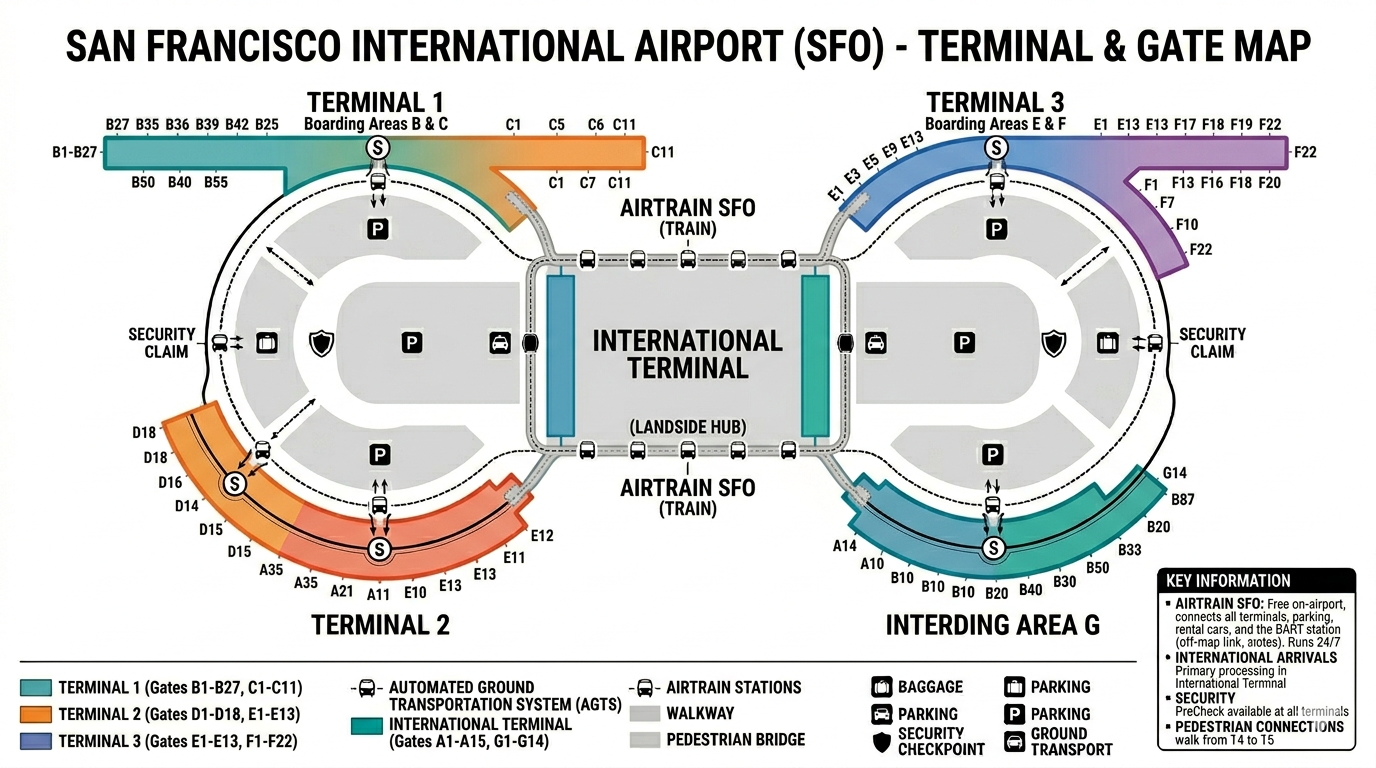 Click image to view full size
San Francisco Airport Location Map
San Francisco International Airport sits 13 miles (21 km) south of downtown San Francisco in an unincorporated area of San Mateo County, immediately alongside US Route 101. The SFO location map below shows the airport’s position on the western edge of San Francisco Bay, between the cities of South San Francisco to the north and Millbrae and Burlingame to the south. US-101 provides direct access from both directions, and Interstate 380 connects to US-101 near the airport entrance.
Interactive map showing San Francisco Airport’s location south of downtown San Francisco on the Bay
View Larger Map
SFO Terminals — Overview
San Francisco International Airport has four terminal buildings arranged in a rough circle. From west to east (counterclockwise as seen from the air): the International Terminal’s A gates sit at the southern tip, Harvey Milk Terminal 1 and Terminal 2 occupy the south-west and south, Terminal 3 sits at the north-east, and the International Terminal’s G gates close the loop at the north. All terminals are connected post-security by airside pedestrian walkways (as of June 2024) and pre-security by the free AirTrain.
Airside Walkways — No Re-Clearing Security
Since June 17, 2024, SFO completed a full ring of post-security airside connectors. You can now walk between any adjacent terminal pair without leaving the secure area: International Terminal A → Terminal 1 → Terminal 2 → Terminal 3 → International Terminal G. Note: there is no direct connector between International Terminal A and G gates. To transfer between them, you must walk through all intervening terminals (allow 20–25 minutes) or exit security and use the AirTrain, then re-clear at the other side.
Harvey Milk Terminal 1 (T1)
Harvey Milk Terminal 1 is the largest domestic terminal at SFO and the first airport terminal in the world to be named after an LGBTQ+ leader. It completed a major $2.4 billion renovation in 2024, adding new gates and a secure Federal Inspection Services connector to the International Terminal. T1 has two boarding areas: the newly expanded Boarding Area B (gates B2–B27) and Boarding Area C (gates C1–C11), which returned to T1 from T2 in October 2024.
T1 is directly accessible from the Domestic Garage via covered walkway, and connects airside to both the International Terminal A gates and to Terminal 2. The terminal received a Fitwel certification in 2020 for its environmentally healthy design.
San Francisco Airport Terminal 2 (T2)
Terminal 2 is the smallest of SFO’s domestic terminals, serving a handful of carriers out of Boarding Area D (gates D1–D18). Originally built in 1954 and renovated in 2011, it was the first US airport terminal to earn LEED Gold status. The temporary American Express Centurion Lounge — relocated here while the permanent T3 lounge is rebuilt — makes T2 a worthwhile stopover for Amex cardholders flying United out of Terminal 3.
The Centurion Lounge is open in Terminal 2 while the permanent T3 location is rebuilt as part of the Terminal 3 West Modernization project (expected to reopen 2027–2028). T2 connects airside to T1 via walkway and to T3 in the other direction. United check-in counters are temporarily located in T2 (west side) during T3W construction.
San Francisco Airport Terminal 3 (T3) — United Airlines Hub
Terminal 3 is United Airlines’ exclusive domestic hub at SFO, with two boarding areas: E (gates E1–E13) and F (gates F1–F22). It is the largest terminal by gate count and handles the bulk of United’s domestic operation. Terminal 3 is currently undergoing a major $2.9 billion renovation of its western half (the T3 West Modernization project), with significant disruptions in effect through 2027.
The Amex Centurion Lounge in Terminal 3 is closed until 2027–2028. A temporary Centurion Lounge has opened in Terminal 2 near gate D12. T3 connects airside to T2 and to International Terminal G. United domestic flights depart from both E and F gates; United Express regional flights use F gates.
SFO International Terminal — Boarding Areas A and G
The International Terminal at SFO is the largest international terminal building in North America, handling virtually all non-US flag carriers and United’s transpacific flights. It is divided into two boarding areas on opposite ends of the main hall: Boarding Area A (gates A1–A15, southern side) and Boarding Area G (gates G1–G14, northern side). Each has its own security checkpoint and adjacent parking garage. The main hall on Level 3 handles check-in for all international departures.
The International Terminal is home to the BART station (Level 4). Boarding Area A connects airside to Harvey Milk Terminal 1; Boarding Area G connects airside to Terminal 3. There is no direct airside connector between the A and G gates — a walk through all intermediate terminals takes around 20–25 minutes. International customs and border protection are on Level 2 (Arrivals).
SFO AirTrain — Getting Between Terminals
The AirTrain is SFO’s free automated people mover running 24 hours a day, 7 days a week, with departures approximately every four minutes. It operates two lines. The Red Line is the key route for inter-terminal travel, stopping at all four terminal buildings, the terminal garages and the BART station. The Blue Line adds stops at Long-Term Parking and the Rental Car Center.
AirTrain Stops and Travel Times
From any terminal, a full loop on the AirTrain takes about 10 minutes. Between any two adjacent terminals the ride is approximately five minutes. The BART/International Terminal station sits on the AirTrain loop, so passengers arriving at any domestic terminal can take the AirTrain to the BART station without leaving the secure zone (boarding the AirTrain is always pre-security). Board the AirTrain on Level 3 or Level 5 at each terminal — follow signs for “AirTrain” or “BART / Ground Transportation”.
SFO Security Checkpoints
Each of SFO’s four terminal areas has its own security checkpoint. All checkpoints offer TSA PreCheck and CLEAR lanes. Terminal 1 has two checkpoints (near B gates and near C gates), Terminal 2 has one checkpoint, Terminal 3 has one consolidated checkpoint (two checkpoints are being merged as part of T3W construction), and the International Terminal has separate checkpoints for Boarding Area A and Boarding Area G, plus a smaller one for international-to-domestic connections near the G gates.
Getting to San Francisco Airport
All ground transportation departs from the Arrivals/Baggage Claim level of each terminal. The BART station is inside the International Terminal and reachable from all other terminals via the AirTrain.
San Francisco Airport Parking
Reserve SFO airport parking in advance at flysfo.com for guaranteed availability and to compare on-airport and off-airport rates.
San Francisco Airport Map — Arrivals
Arriving passengers collect baggage on the Arrivals/Baggage Claim level of their terminal. Domestic arrivals proceed directly to baggage claim after deplaning. International arrivals clear US Customs and Border Protection on Level 2 of the International Terminal, then collect bags from the international carousels before exiting to the arrivals hall. If connecting to a domestic flight, do not exit the customs hall — follow “Connections” signs to reach the secure area and use the airside walkway or AirTrain to your departure terminal.
Ground Transportation from Arrivals
From the Arrivals level of any terminal, you can access BART via the AirTrain (free, board at any terminal), ride-shares on the Domestic Garage Level 5 island, taxis curbside, shared-ride vans at the centre island, and rental car shuttles to the Rental Car Center via the AirTrain Blue Line. If being picked up by car, use the free Cell Phone Waiting Lot off US-101 and collect your passenger curbside at the Arrivals level.
San Francisco Airport Map — Departures
Departing passengers enter SFO at the Departures level of their terminal. Check in at your airline’s ticket counter or self-service kiosk, drop your bags, then proceed to the security checkpoint for your terminal. After clearing security, use the airside walkways or wait at your gate. If your terminal’s curb access is affected by T3W construction — as is the case for Terminal 3 curb doors 6–13 through 2027 — use Terminal 2’s curbside drop-off instead.
Recommended Arrival Times
Arrive at least two hours before domestic flights and three hours before international flights. SFO’s peak security periods are weekday mornings (5–9 a.m.) and Sunday evenings. TSA PreCheck and CLEAR lanes are available at all checkpoints and significantly reduce screening time. Gate assignments are shown on flight information displays throughout each terminal and in your airline’s app.
Insider Tips
SFO sits on the Bay and is notorious for summer fog — Karl the Fog frequently causes delays in June and July even when skies elsewhere are clear. Build buffer time in summer. For terminal transfers, the airside walkways are now fully connected, but A-to-G is a long walk: use the AirTrain if you have a tight connection between those boarding areas. The SFO Museum is free and accessible in the International Terminal — worth a browse if you have time. Fog delays tend to occur in the afternoon; book morning departures for greater on-time reliability. BART accepts contactless bank cards, Apple Pay and Google Pay — no Clipper card required.
San Francisco Airport Map — FAQ
How many terminals does SFO have?
SFO has four terminals: Harvey Milk Terminal 1 (gates B2–B27 and C1–C11), Terminal 2 (gates D1–D18), Terminal 3 (gates E1–E13 and F1–F22) and the International Terminal (gates A1–A15 and G1–G14). All four are connected airside by pedestrian walkways and pre-security by the free AirTrain.
Which airlines fly from each terminal at SFO?
Terminal 1: Alaska, American, Delta, JetBlue, Southwest. Terminal 2: Air Canada, Breeze Airways. Terminal 3: United Airlines exclusively. International Terminal: United (international), plus Air China, ANA, Asiana, British Airways, Cathay Pacific, Emirates, Lufthansa, Singapore Airlines, Turkish Airlines and many more.
How do I get between terminals at SFO?
Post-security: airside pedestrian walkways connect all adjacent terminals (ITB-A → T1 → T2 → T3 → ITB-G), no re-screening needed. Pre-security: the free AirTrain connects all terminals every ~4 min, 24/7.
How do I get from SFO to downtown San Francisco?
BART: ~30 min, $11.15 one-way, station inside the International Terminal (AirTrain from any terminal). Runs 5 a.m.–midnight weekdays, 6 a.m.–midnight weekends. Ride-share: 20–40 min, $35–$60. Taxi: 20–40 min, $50–$70.
Where is the BART station at SFO?
Inside the International Terminal on Level 4. Take the free AirTrain from any domestic terminal to the BART/International Terminal stop. Yellow and Red Lines run to downtown SF stations (Embarcadero, Montgomery, Powell, Civic Center).
Is Terminal 3 under construction in 2026?
Yes. The $2.9 billion T3 West Modernization project began August 2024 and completes in fall 2027. Gates F1–F4 are offline, T3 departure curb doors 6–13 are closed (use T2 curbside), and United has opened temporary check-in at Terminal 2. Airside walkways remain open via temporary corridors.
Where can I park at SFO?
Domestic Garage (walkway to T1–T3, up to $36/day), International Garages A and G (adjacent to ITB, up to $36/day), Long-Term Garage and Surface Lot ($25/day, AirTrain Blue Line), off-airport lots (~$12/day with free shuttle). Free Cell Phone Waiting Lot (60 min max).
What is the AirTrain at SFO?
A free automated people mover running 24/7 every ~4 min. Red Line: all terminals, terminal garages, BART station, Grand Hyatt. Blue Line: all terminals, Long-Term Parking, Rental Car Center. Board inside each terminal on Level 3 or Level 5 following AirTrain signs.
Can I walk between terminals at SFO?
Yes, post-security. Since June 2024, airside walkways connect all adjacent terminals without re-clearing security. The full walk from International Terminal A gates to G gates (through T1, T2 and T3) takes about 20–25 minutes. For faster terminal-to-terminal transfer, exit security, take the AirTrain, and re-clear at the destination terminal.