San Jose Airport Map & Terminal Guide 2026
Two terminals, 36 gates, Silicon Valley's airport. Everything you need to navigate Norman Y. Mineta San José International Airport (SJC) — Terminal A, Terminal B, security, the airside connector, parking and transport.
San Jose Airport Map
The San Jose Airport map below shows the full layout of Norman Y. Mineta San José International Airport (SJC/KSJC) — Silicon Valley's hometown airport. SJC served nearly 12 million passengers in 2024, making it the second-busiest airport in the Bay Area after San Francisco International. It is the dominant hub for Southwest Airlines, which accounts for roughly half of all passengers, with Alaska Airlines the next largest carrier. The airport also handles international flights to Tokyo, London, and Mexico.
As you can see on the San Jose Airport map, the layout is refreshingly compact: two side-by-side terminals (A and B) connected airside by a pedestrian walkway between Gates 16 and 17. There is no underground train — both terminals, the Rental Car Center and most parking lots are within easy walking distance or a short shuttle ride of each other.
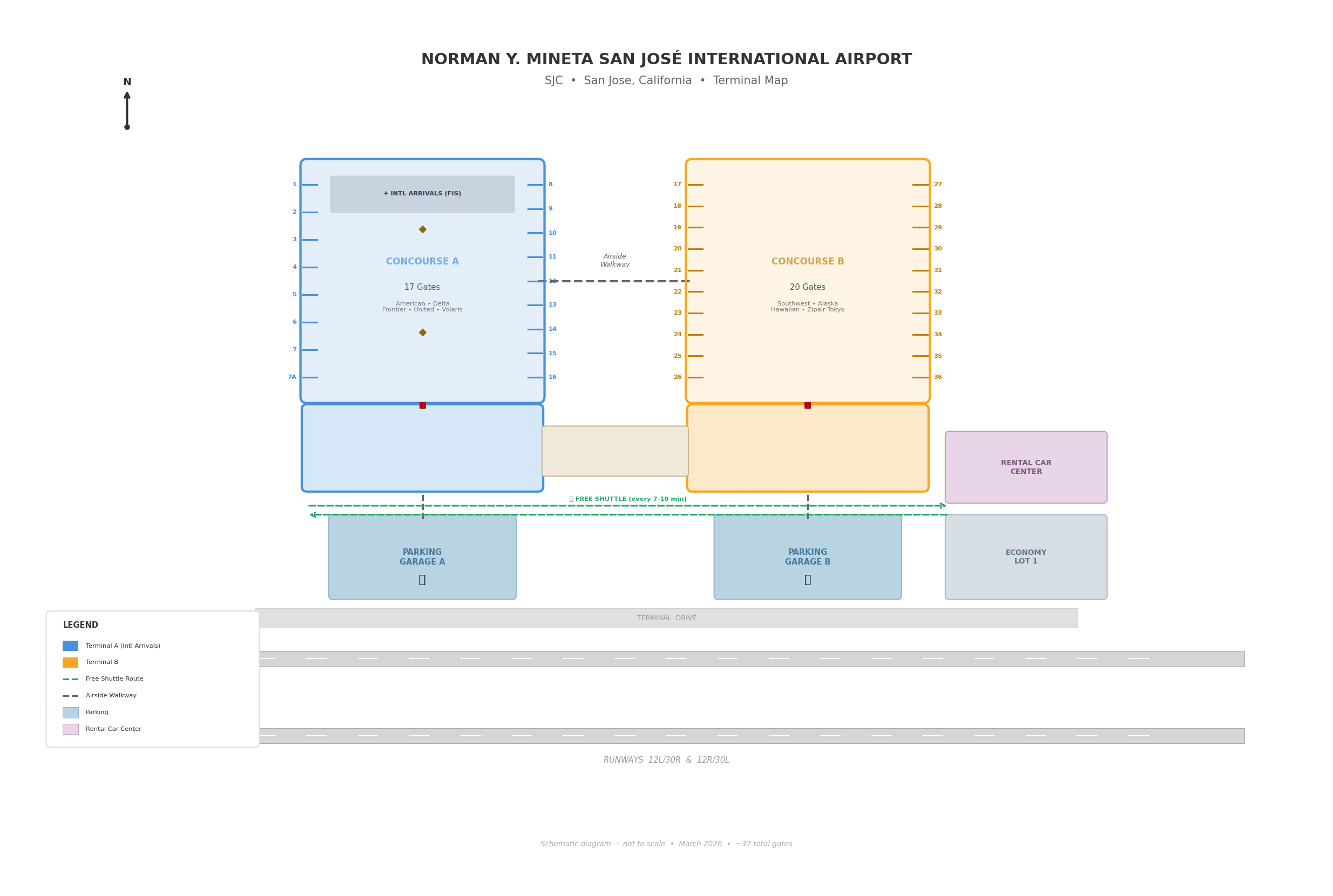 Click image to view full size
San Jose Airport Location Map
Norman Y. Mineta San José International Airport is located 3.9 miles (6.3 km) northwest of downtown San Jose, inside the city limits — one of the few major US airports truly embedded within its city. The San Jose Airport location map below shows SJC's position relative to Silicon Valley's freeway grid. The airport is served by US Route 101, Interstate 880 and State Route 87, with Airport Boulevard running directly between the two terminals.
San Jose Airport Terminals
SJC has two passenger terminals: Terminal A and Terminal B. Both were built or fully renovated as part of a $1.3 billion modernisation program completed in 2010 — meaning the airport feels notably modern and well-maintained. The terminals sit side by side along Airport Boulevard, with the Rental Car Center directly opposite Terminal B. Each terminal has its own ticketing level (lower/ground floor), security checkpoint and departures concourse (upper floor).
Terminal Layout at a Glance
San Jose Airport Terminal A
Terminal A is the older and smaller of the two terminals, handling domestic flights and all international departures and arrivals at SJC. The international arrivals area — with US Customs and Border Protection — is in a dedicated building on the lower level near Gates 15 and 16. Terminal A is also home to both of SJC's pay-per-use lounges.
International arrivals clear customs in the separate arrivals building near Gates 15–16. The Club at SJC lounges sell walk-in access at $45 per person ($40 for AAA members) and include food, drinks, Wi-Fi and showers. Priority Pass members enter free.
San Jose Airport Terminal B
Terminal B is the newer, larger terminal and the heart of SJC's domestic operation. Southwest Airlines dominates, operating roughly 50% of all flights at SJC from Terminal B's 19 gates. The terminal opened in 2010 with LEED Silver certification and features dramatic daylighting, personal power outlets at every seat and an airside concourse walkway connecting north to Terminal A.
There are no terminal lounges inside Terminal B airside. The two Club at SJC pay lounges are in Terminal A — use the airside connector (Gates 16–17) to reach them before or after clearing security. Gates 17–25 are on the right of the security checkpoint; Gates 26–35 are on the left.
Getting Between Terminals at San Jose Airport
Moving between Terminal A and Terminal B at SJC is straightforward compared to larger airports. Airside (after clearing security), a pedestrian walkway connects the concourses directly between Gate 16 in Terminal A and Gate 17 in Terminal B — the walk takes around two to three minutes with no train required. This means connecting passengers can transfer between terminals without re-clearing security.
Landside (before security or after baggage claim), a free shuttle bus runs continuously between Terminal A, Terminal B, the Rental Car Center and the parking lots every 7–10 minutes around the clock. At Terminal A, board at Stop 6 on the ground transportation island. At Terminal B, board at Stop 3 or 4 on the island across from baggage claim.
San Jose Airport Security Checkpoints
Each terminal has its own dedicated TSA security checkpoint on the upper (departures) level. There is no shared security hall — choose the checkpoint for your terminal when you check in. Both checkpoints have TSA PreCheck lanes and CLEAR is also available at SJC.
San Jose Airport Terminal A — International Flights
All international departures and arrivals at SJC are processed through Terminal A. International flights currently operate to Tokyo (ZIPAIR), London (British Airways), and multiple Mexican destinations (Volaris). International departures check in and clear US Customs preclearance (where applicable) in Terminal A's departures building. All international arrivals — except flights arriving from airports with US border preclearance — must clear US Customs and Border Protection in the dedicated International Arrivals building near Gates 15 and 16. Currency exchange is available at the arrivals building and near Gate 15 airside.
Getting to San Jose Airport
SJC's central Silicon Valley location means most passengers are within 20 miles of the terminals. Ground transportation departs from the curbside ground transportation islands at both Terminal A and Terminal B.
San Jose Airport Parking
SJC offers six on-site parking options, with lots close to both terminals. Pre-book Economy Lot 1 in advance at flysanjose.com to guarantee availability at the cheapest on-site rate.
San Jose Airport Map — Arrivals
Arriving passengers land at either Terminal A or Terminal B, depending on their airline. After deplaning, domestic arrivals ride the escalator or lift down to baggage claim on the lower level of their terminal. International arrivals follow signage to the International Arrivals building at Terminal A (near Gates 15–16), clear US Customs and Border Protection, then collect bags and proceed to ground transportation on the lower level.
Ground Transportation from Arrivals
At Terminal A, exit baggage claim to the curbside ground transportation island for taxis (Stop 2), ride-shares (Stop 1) and the free inter-terminal shuttle (Stop 6). At Terminal B, cross to the ground transportation island for ride-shares (Stops 8 & 9), taxis (Stop 1) and the inter-terminal shuttle (Stop 3 or 4). The free VTA Route 60 Airport Flyer bus stops at Terminal A Stop 7 and Terminal B Stop 5 for connections to light rail, Caltrain, BART and ACE Rail.
San Jose Airport Map — Departures
Departing passengers should go to the terminal indicated on their booking: Terminal A for Delta, United, JetBlue, American, Frontier and Volaris; Terminal B for Southwest, Alaska, Hawaiian and Spirit. ZIPAIR passengers check in at Terminal B but must then cross to Terminal A (use the airside walkway after security, or the landside shuttle before check-in). Enter the terminal on the lower level for check-in and bag drop, then proceed upstairs to your terminal's security checkpoint. Gates 17–25 are to the right of Terminal B's checkpoint; Gates 26–35 are to the left.
Recommended Arrival Times
Arrive at least 90 minutes before domestic departures and 2.5 to 3 hours before international flights. SJC is generally efficient at security but peak morning times (roughly 5–8 a.m.) can be busy. Check your airline's app for gate assignments, as Terminal B in particular has gates spread across both sides of the security checkpoint.
Insider Tips
SJC is genuinely one of the easiest major US airports to navigate — small enough to feel human-scale, modern enough to be comfortable. Free Wi-Fi (network: sjcfreewifi) averages over 200 Mbps and requires no registration. Power outlets line nearly every gate. ZIPAIR passengers: note your flight departs Terminal A even though check-in is in Terminal B — budget an extra 10 minutes to cross terminals after the security checkpoint. The two Club at SJC lounges ($45 walk-in) are both in Terminal A — Terminal B passengers should enter security, then walk the airside connector to access them. If picking someone up, use the free cell phone waiting lots on Airport Parkway rather than circling the terminals.
San Jose Airport Map — FAQ
How many terminals does San Jose Airport have?
Two terminals: Terminal A (Gates 1–16, 17 gates) and Terminal B (Gates 17–35, 19 gates). They are connected airside via a pedestrian walkway between Gates 16 and 17, so connecting passengers do not need to re-clear security.
How do I get between terminals at SJC?
Airside (after security), walk the concourse connector between Gates 16 and 17 — about 2–3 minutes. Landside, the free inter-terminal shuttle loops both terminals, the Rental Car Center and parking lots every 7–10 minutes, 24/7.
Which airlines fly from each terminal at San Jose Airport?
Terminal A: Delta, United, JetBlue, American, Frontier, Volaris, and all international flights. Terminal B: Southwest (dominant, ~50% of passengers), Alaska, Hawaiian, Spirit. ZIPAIR check-in is in Terminal B but flights depart from Terminal A.
Where is security at San Jose Airport?
Each terminal has its own security checkpoint on the upper (departures) level. Terminal A opens at 4 a.m. Both have TSA PreCheck and CLEAR. There is no shared security hall.
How far is San Jose Airport from downtown?
3.9 miles northwest. Driving via SR-87 or US-101: 10–20 min. Free VTA Route 60 bus to the Metro/Airport LRT station: ~5 min. From there, VTA light rail reaches downtown San Jose in about 10 minutes.
Is there a train to San Jose Airport?
There is no direct rail connection to the terminal. The free VTA Route 60 Airport Flyer bus runs every 15–30 minutes (5:30 a.m.–12:16 a.m.) connecting both terminals to Milpitas BART and Santa Clara Caltrain/ACE Rail.
Where can I find parking at San Jose Airport?
On-site: Hourly Lot 2 (Terminal A, $24/day), Hourly Lot 3 (Terminal B, $38/day), Daily Lots 4 & 5 ($30/day), Economy Lot 1 ($18/day, cheapest, free shuttle). Pre-book at flysanjose.com.
What does the San Jose Airport map show?
The SJC airport map shows Terminal A (Gates 1–16) and Terminal B (Gates 17–35), the airside connector between Gates 16 and 17, security checkpoints, baggage claim areas, the International Arrivals building, the Rental Car Center, parking lots 1–5, VTA bus stops and the surrounding road network including US-101, I-880 and SR-87.