Seattle Airport Map & Terminal Guide 2026
One central terminal, four concourses, two satellite terminals, 103 gates. Everything you need to navigate Seattle-Tacoma International Airport (SEA) — concourses A, B, C & D, North & South Satellites, security, parking and the Link Light Rail.
Seattle Airport Map
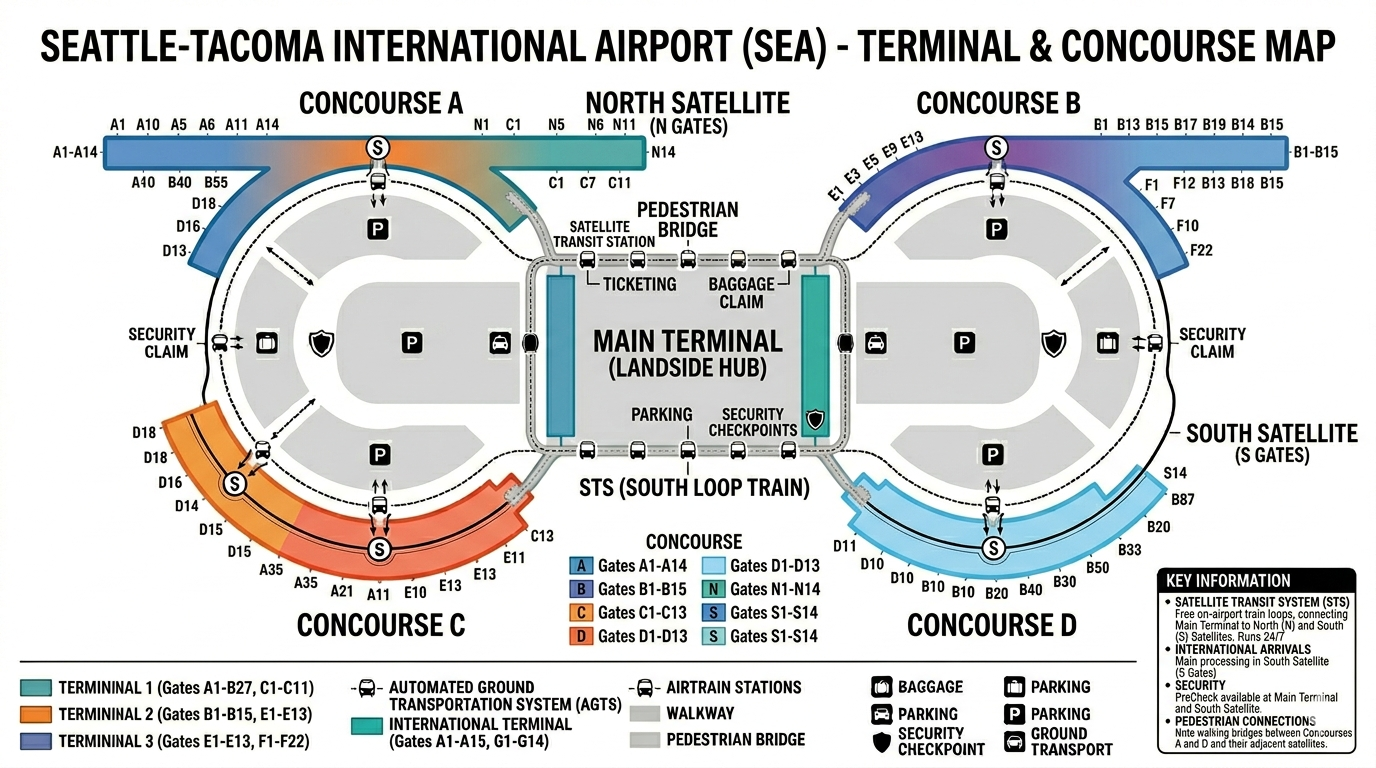
The Seattle Airport map below shows the full layout of Seattle-Tacoma International Airport (SEA/KSEA) — known locally as Sea-Tac. SEA set an all-time passenger record in 2025 with 52.7 million travellers, making it the 11th-busiest airport in the United States. It is the primary hub for Alaska Airlines and a major international gateway for Delta Air Lines, with 37 carriers serving 96 domestic and 37 international destinations.
As you can see on the Seattle Airport map, the layout centres on a single Central Terminal with four concourses (A, B, C and D) branching off in an “X” formation, plus two detached satellite terminals — the North Satellite (N Gates) and the South Satellite (S Gates) — connected via the SEA Underground automated people mover. Study the SEA airport map before you travel so you know which concourse your airline uses.
 Click image to view full size
Seattle Airport Location Map
Seattle-Tacoma International Airport is located approximately 14 miles (23 km) south of downtown Seattle and 18 miles (29 km) north of downtown Tacoma, in the city of SeaTac, Washington. The Seattle Airport location map below shows SEA’s position relative to the wider Puget Sound region. The airport is primarily accessed via International Boulevard (SR-99) and connects to Interstate 5 for travel north to Seattle or south to Tacoma.
Interactive map showing Seattle-Tacoma International Airport’s location south of downtown Seattle
View Larger Map
Seattle Airport Central Terminal
The Central Terminal (also called the Main Terminal) is the sole landside building at Seattle-Tacoma International Airport, handling all check-in, security screening, baggage claim and ground transportation. It spans multiple levels and is divided roughly north–south, with Alaska Airlines check-in counters at the north end and Delta Air Lines counters at the south end. All four concourses branch off from the Central Terminal after security, and the SEA Underground trains to the satellite terminals depart from platforms within the secure zone.
Central Terminal Levels
Seattle Airport Security Checkpoints 2026
All Seattle Airport security screening takes place in the Central Terminal. There are five active checkpoints in total — one on the baggage claim level (Level 3) and four on the ticketing level (Level 5). All checkpoints lead to all gates regardless of which concourse or satellite terminal you are departing from.
SEA Underground — Satellite Train System
Seattle Airport Concourse A — Delta Hub
Concourse A is the largest concourse at Sea-Tac, extending from the southeast corner of the Central Terminal. It is the primary hub for Delta Air Lines and SkyTeam partners, with 16 departure gates serving a mix of domestic and international flights. Concourse A also houses the International Arrivals Facility (IAF) entrance and is the direct landside connection point for international passengers clearing U.S. Customs after arriving at the South Satellite.
Gates A1–A4 are closest to the Blue Line SEA Underground platform for fast connections to the South Satellite. The IAF is adjacent to Concourse A — international arrivals clear Customs here before proceeding to baggage claim.
Seattle Airport Concourse B
Concourse B sits on the southwest side of the Central Terminal with approximately 17 gates. It primarily handles domestic Southwest Airlines flights and some Delta domestic routes, offering a good selection of dining options and quick walkable access to the Central Terminal.
Concourse B is accessible on foot from Concourse A and the Central Terminal. The Blue Line SEA Underground to the South Satellite departs near the B/A corridor. Expect high morning and evening crowds when Southwest runs peak departures.
Seattle Airport Concourse C — Alaska Airlines
Concourse C is located on the northwest side of the Central Terminal and serves as Alaska Airlines’ primary domestic hub. The Alaska Lounge is on the mezzanine level near gate C16, and the Green Line SEA Underground to the North Satellite departs from this area.
Checkpoints 4 and 5 provide the quickest access to Concourse C. From C or D, take the Green Line to reach the North Satellite if your Alaska flight departs from an N gate.
Seattle Airport Concourse D
Concourse D is the northernmost of the four main concourses, serving United Airlines and international carriers. It connects directly to Concourse C on foot and is the other Green Line boarding point for passengers heading to the North Satellite.
Concourse D is walkable from Concourse C. The Yellow Line SEA Underground provides an additional connection between Concourse D and Concourse A for passengers making connections across the terminal.
Seattle Airport North Satellite Terminal — Alaska Airlines
The North Satellite is Alaska Airlines’ expanded hub at Sea-Tac, completed and expanded to 20 gates in a $550 million modernisation project that concluded in 2021. Reach it via the Green Line SEA Underground train from near Concourses C or D — the ride takes about 3 minutes. The North Satellite has no direct walking connection to the Central Terminal.
The North Satellite is Alaska Airlines’ flagship lounge location, with a two-level Alaska Lounge offering panoramic views of Mount Rainier on clear days. The American Express Centurion Lounge here is one of the busiest in the network — arrive early during peak hours.
Seattle Airport South Satellite Terminal — International Gateway
The South Satellite is Sea-Tac’s international terminal, handling most long-haul and overseas departures and all non-precleared international arrivals. Reach it via the Blue Line SEA Underground from near Concourses A or B — approximately 2 minutes. The 2022 International Arrivals Facility (IAF) is connected to the South Satellite via a 900-foot elevated sky-bridge over the taxiway to Concourse A, where passengers clear U.S. Customs and Border Protection.
All non-precleared international arrivals come through the South Satellite or Concourse A. If continuing on a connecting domestic flight after an international arrival, allow 45–90 minutes to clear Customs at the IAF, re-check bags, and clear security again before proceeding to your gate.
Getting Between Concourses at Seattle Airport
Concourses A, B, C and D are all connected on foot via the Central Terminal’s secure zone, so transferring between them requires no additional train ride. The two satellite terminals, however, require the SEA Underground people mover. The Blue Line connects the Central Terminal (near Concourses A/B) to the South Satellite, while the Green Line connects the Central Terminal (near Concourses C/D) to the North Satellite. A Yellow Line provides an additional cross-terminal link between Concourse D and Concourse A for connecting passengers.
Connection Tips
For domestic-to-domestic connections within the main concourses, 30 minutes is generally sufficient. Connections involving the South Satellite for international arrivals are the most time-intensive: factor in the Customs process at the IAF, bag reclaim, security re-entry and the train ride. Allow at least 60–90 minutes for international-to-domestic connections, and check your airline’s minimum connection time. Security wait times are posted on the digital displays throughout the Central Terminal and on portseattle.org in real time.
Getting to Seattle Airport
All public transit and ground transportation departs from Level 3 (baggage claim) of the Central Terminal and the adjacent parking garage.
Seattle Airport Parking
Pre-book parking at portseattle.org for guaranteed availability, especially during summer and holiday periods. SEA has a single main parking garage directly connected to the terminal.
Seattle Airport Map — Arrivals
Domestic arrivals deplane at their concourse (A, B, C, D, or a satellite terminal), then walk or take the SEA Underground train back to the Central Terminal and descend to Level 3 for baggage claim. Carousels are numbered and assigned by airline; Delta typically uses the southern carousels (1–8) and Alaska the northern ones.
International Arrivals at Sea-Tac
All non-precleared international arrivals land at the South Satellite or Concourse A. Passengers arriving at the South Satellite travel via the elevated International Arrivals sky-bridge over the taxiway to the dedicated International Arrivals Facility (IAF) adjacent to Concourse A, where they clear U.S. Customs and Border Protection. After clearing customs, baggage is collected in the IAF’s dedicated claim hall on Level 3. Passengers continuing on a connecting flight must re-enter security — all five checkpoints are accessible from the Central Terminal. Passengers with Global Entry or Mobile Passport Control benefit from expedited kiosk processing in the IAF. Allow at least 60–90 minutes for international arrival processing before a domestic connection.
Seattle Airport Map — Departures
Departing passengers enter the Central Terminal on Level 5 (ticketing level) via curbside drop-off or the parking garage walkway. Check in at your airline’s counter, then proceed to the nearest security checkpoint. Alaska Airlines counters are at the north end; Delta is at the south end. After clearing security, follow the concourse signs. If your gate is in the North or South Satellite, board the SEA Underground train from within the secure zone — signs are clearly marked for the Blue and Green Lines.
Recommended Arrival Times
Allow at least two hours before domestic departures and three hours before international flights. Checkpoint 4 is open 24 hours and is useful for very early or very late departures. For the busiest 4–9 a.m. security window, use free SEA Spot Saver to reserve a time slot at Checkpoint 2 or 4 and avoid unpredictable queue lengths.
Insider Tips
Sea-Tac regularly wins top North American airport awards but operates well above its original design capacity — peak summer days see over 170,000 passengers. Book parking and print or download boarding passes ahead of time. If you are connecting between international and domestic flights, always ask your airline about minimum connection times at SEA: the IAF customs process plus security re-entry adds time that many travellers underestimate. On clear days, the North Satellite rooftop terrace and many aircraft windows offer views of Mount Rainier to the southeast — sit on the right side of the plane departing southbound for the best angle.
Seattle Airport Map — FAQ
How many terminals does Seattle Airport have?
One Central Terminal with four concourses (A, B, C, D) plus two satellite terminals — the North Satellite (N Gates, Alaska Airlines) and the South Satellite (S Gates, most international flights). All are connected by the SEA Underground automated people mover after security.
How do I get between concourses at Seattle Airport?
Concourses A, B, C and D are all walkable from the Central Terminal after security. The North Satellite is reached via the Green Line SEA Underground train from Concourses C or D (~3 min). The South Satellite is reached via the Blue Line from near Concourses A or B (~2 min). No train ride is needed to transfer between the four main concourses.
Which airlines fly from each concourse at Sea-Tac?
Concourse A: Delta, JetBlue, Air Canada. Concourse B: Southwest, Delta domestic. Concourse C: Alaska Airlines. Concourse D: United, Frontier, international carriers. North Satellite: Alaska Airlines exclusively. South Satellite: British Airways, Delta international, Emirates, EVA Air, Hawaiian, Japan Airlines, Korean Air, Lufthansa, Air New Zealand, ANA and others.
Where is security at Seattle Airport in 2026?
Five checkpoints, all in the Central Terminal. Checkpoint 1 is on Level 3 (baggage claim level), open 4 a.m.–8 p.m. Checkpoints 2–5 are on Level 5 (ticketing level). TSA PreCheck is at Checkpoints 2 and 5. CLEAR at Checkpoints 1 and 5. Free SEA Spot Saver reservations at Checkpoints 2 and 4. All checkpoints access all gates.
How far is Seattle Airport from downtown?
About 14 miles south. Link Light Rail: ~38 min to Westlake Station, $3.00 adult fare. Taxi/ride-share: 20–40 min, $50–$70 depending on traffic.
How do I get from Sea-Tac to downtown Seattle by train?
From baggage claim, follow “Link Light Rail” signs to Level 4, cross the skywalk to the garage station, buy a ticket or tap to pay ($3.00 adult), and board the 1 Line toward Lynnwood. Exit at Westlake, University Street or Pioneer Square for central downtown. Journey time: ~38 minutes.
What is SEA Spot Saver?
A free security line reservation offered by the Port of Seattle for general-screening passengers. Book a time at Checkpoint 2 or 4 up to five days in advance at portseattle.org/SEAspotsaver. Available 4 a.m.–10 p.m. daily. Cannot be used with TSA PreCheck or CLEAR.
Where can I find Seattle Airport parking?
The main parking garage is directly connected to the terminal. Floors 1–3 and 5–8 are general drive-up parking. Floor 4 is reserved parking, bookable up to 120 days ahead at portseattle.org. The Link Light Rail at $3 is the most affordable alternative for travellers from Seattle or the Eastside.
What does the Seattle Airport map show?
The Seattle Airport map shows the Central Terminal, all four concourses (A–D), the North and South Satellite terminals, the SEA Underground Blue and Green train lines, the five security checkpoints, the parking garage, the Link Light Rail station on Level 4, ground transportation areas, International Boulevard and SR-99 access roads. Use the SEA airport map to find your concourse before you arrive.
Is SEA the same as Sea-Tac?
Yes. SEA is the official IATA code; Sea-Tac is the common local nickname, taken from the city of SeaTac where the airport sits between Seattle and Tacoma. Both refer to Seattle-Tacoma International Airport, 17801 International Blvd, SeaTac, WA 98158.