Zurich Airport Map & Terminal Guide 2026
One integrated terminal, three check-in buildings, three gate areas. Everything you need to navigate Zurich Airport (ZRH) — Switzerland’s largest international airport and the primary hub of Swiss International Air Lines.
Zurich Airport Map
The Zurich Airport map below shows the full layout of ZRH (IATA: ZRH, ICAO: LSZH), the largest international airport in Switzerland. ZRH handled 32.6 million passengers in 2025 and connects to 198 cities across 74 countries. It serves as the primary hub for Swiss International Air Lines (SWISS), which accounts for roughly 52% of all passenger volume, and is also a base for Edelweiss Air, Helvetic Airways and Chair Airlines.
As you can see on the Zurich Airport map, ZRH operates as a single integrated terminal complex rather than separate terminals. The key distinction for travellers is the Schengen vs non-Schengen split: flights within Europe’s passport-free zone use Gates A and B, while flights to non-Schengen destinations (including the US, UK, UAE and most long-haul routes) use Gates D and E. Gates E are in a physically separate satellite building called Dock E, reached by the free Skymetro automated train. Study the ZRH airport map carefully before you travel so you know which gate area applies to your flight.
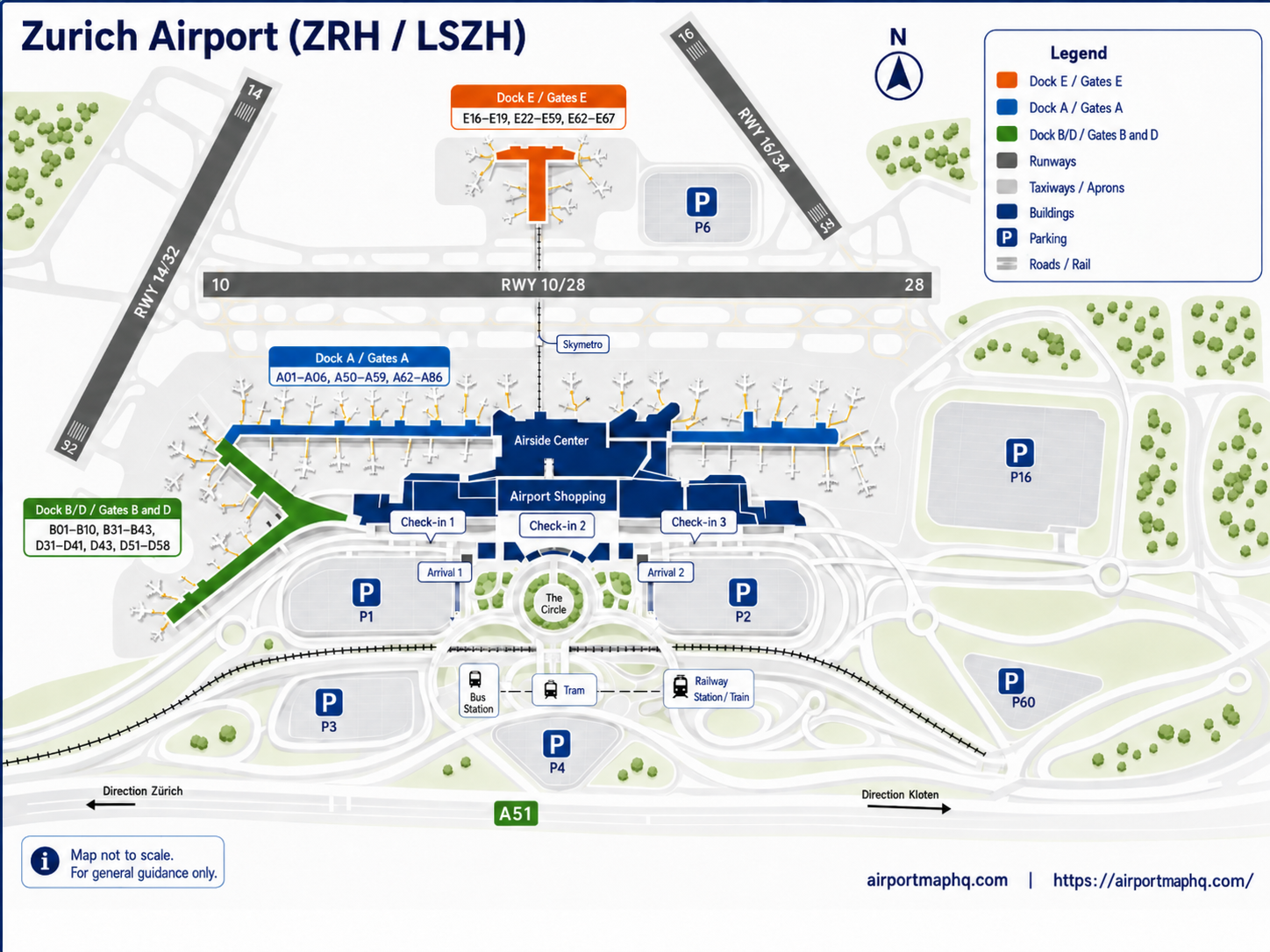 Click image to view full size
Zurich Airport Location Map
Zurich Airport is located approximately 9 km (5.5 miles) north of central Zurich, in the municipality of Kloten within the canton of Zurich. The ZRH airport location map below shows the airport’s position relative to the city centre. The SBB train station sits directly beneath the terminal, making ZRH one of the most seamlessly connected airports in Europe for onward rail travel across Switzerland.
How Zurich Airport Is Organised
ZRH differs from most airports because it does not use the word “terminal” the same way other airports do. It operates as one integrated complex with two distinct zones: the landside Airport Centre (public area for check-in, arrivals, retail and transport) and the airside Airside Centre (the post-security zone for all departing passengers). The Airside Centre is the central hub that connects to three gate piers.
The single most important thing to know at ZRH is whether your flight is Schengen or non-Schengen. Switzerland is a Schengen member, so flights to other Schengen countries (most of continental Europe) are treated like domestic departures. Flights to non-Schengen destinations (UK, US, UAE, most of Asia, Africa, the Americas) require passport control. That split determines which gate area you use and how much connection time you need.
Zurich Airport Gates A — Schengen Flights
Gates A is a finger pier connected directly to the Airside Centre and handles Schengen-only flights. If you are flying to a destination within the Schengen Area (Germany, France, Spain, Italy, the Netherlands, Austria and most of continental Europe), your gate will carry an A prefix. No passport control is required at any point for pure Schengen travel. Family services including play areas and baby-changing facilities are located in the Gates A area.
Gates A is the closest pier to the Security Check Building and is fully reachable on foot from the Airside Centre. No train or people mover needed. Allow 15–20 minutes from check-in to the gate for standard Schengen connections.
Zurich Airport Gates B/D — Dual Schengen and Non-Schengen
Gates B/D is the most unusual feature of ZRH’s layout. It is a single physical finger pier connected to the Airside Centre, but every gate has two numbers: a B prefix for Schengen departures and a D prefix for non-Schengen departures from the same physical gate. The infrastructure splits passenger flows so Schengen and non-Schengen passengers are processed separately even at the same boarding bridge. If your gate is B28, you travel as a Schengen passenger. If it is D28, you travel as a non-Schengen passenger and must pass through passport control in the Airside Centre first.
The SWISS First Lounge and a Transit Hotel (showers, rest rooms) are located in the D gates area, accessible to non-Schengen passengers with the relevant boarding pass or status. The B/D pier is reachable on foot from the Airside Centre.
Zurich Airport Gates E — Dock E International Terminal
Dock E, also called the midfield terminal, is a standalone satellite building that handles all non-Schengen international flights. It sits on the far side of runway 10/28 and is entirely separated from the main terminal complex. All Gates E departures are non-Schengen. Non-Schengen passengers must clear passport control in the Airside Centre before boarding the Skymetro to reach Dock E. Schengen passengers cannot access Dock E via the airside route. This is where most long-haul flights depart, including all SWISS intercontinental routes and carriers such as Emirates, British Airways, Singapore Airlines and United.
Dock E has its own full set of dining, duty-free and lounge options. The free Observation Deck E is open to all passengers with a boarding pass. Allow extra time: you need to clear passport control and then ride the Skymetro before reaching your gate.
The Skymetro — Getting to Dock E
The Skymetro runs entirely within the non-Schengen airside zone. Once on board, it runs non-stop to Dock E with no intermediate stations. If there is a Skymetro disruption (rare but possible), passengers are moved to Dock E by apron bus. Treat the Skymetro as a hard dependency in your connection planning: if you miss it, your recovery options are limited once you are in the satellite terminal.
Zurich Airport Security
ZRH uses a centralised security model. All departing passengers pass through one Security Check Building, which feeds into the Airside Centre. There are no gate-level security checkpoints at individual piers. After clearing security, you have access to the full Airside Centre including duty-free, dining and the lounge zone before deciding whether to head to Gates A, B/D or to passport control for the Skymetro to Dock E.
Getting to Zurich Airport
Zurich Airport has one of the best public transport connections of any European airport. The train station sits directly beneath the terminal, and ZRH’s integrated rail links allow passengers to travel onwards across Switzerland to mountain resorts, lakes and cities without changing at Zurich city centre. Pre-book parking at flughafen-zuerich.ch.
Zurich Airport Parking
ZRH has over 10,000 parking spaces across a network of multi-storey garages, all with covered walkways or direct connections to the terminal buildings. Short-term and long-term tariffs vary by garage. Valet parking is available at Check-in 1 and P3.
Zurich Airport Lounges
ZRH has a large lounge offering spread across all gate areas. SWISS operates nine lounges in total, covering First, Senator, Business and Arrival categories. Independent pay-per-use lounges are available for passengers without status.
Zurich Airport Arrivals
Arriving passengers reach one of two arrivals halls depending on which terminal their flight uses. Schengen arrivals exit directly through Arrivals Hall 1 or 2 without passport control. Non-Schengen arrivals from Dock E clear passport control and customs before exiting into the public arrivals area. Baggage claim carousels are well signposted in both halls.
Ground Transport from Arrivals
The SBB train station is directly accessible from both arrivals halls via escalators and lifts. Taxis queue outside Check-in 1 and 2. Car hire desks are in the arrivals area. The Zurich Tourism information point is located in Arrivals Hall 1 (open 06:00–23:00) and Arrivals Hall 2 (same hours). You can also check luggage in at Zurich Hauptbahnhof station and have it transported directly to your departing flight via the SBB Air Rail service, avoiding the need to carry bags through the city.
Zurich Airport Departures
Departing passengers should go to the check-in building for their airline: Check-in 1 or 3 for SWISS and Lufthansa Group carriers, Check-in 2 for all others. Check in and drop bags, then proceed to the Security Check Building. After clearing security, all passengers arrive in the Airside Centre, where duty-free shopping and dining are available. At this point, Schengen passengers head directly to Gates A or B. Non-Schengen passengers must clear passport control before boarding the Skymetro to Dock E or proceeding to D gates.
Recommended Arrival Times
For Schengen flights: arrive at the airport 90 minutes before departure. For non-Schengen international flights: arrive 2 hours before departure. During peak morning and evening departure banks, or if you are connecting between Schengen and non-Schengen flights, allow extra time for passport control queues. The SWISS Air Rail service lets you check in luggage at Zurich HB station and skip bag drop at the airport, saving time on departure.
Insider Tips for Navigating ZRH
The single most common mistake at ZRH is arriving at the wrong check-in area. SWISS uses Check-in 1 and 3; all other airlines use Check-in 2. These are separate buildings, so arriving at the wrong one costs 5–10 minutes. The second most common error is underestimating the time needed to clear passport control and ride the Skymetro to Dock E for non-Schengen departures. The queues at the passport control hall (not the security hall) are where time gets lost.
The Airside Centre is your last point of flexibility before committing to the Dock E path. The Transfer desk sits near the B/D pier entrance close to the Sprüngli shop — if you have a connection problem, stop there before entering passport control and the Skymetro, as recovery options shrink once you are in the satellite terminal. Konfiserie Sprüngli is also worth noting as a genuine Swiss chocolate stop. Free Wi-Fi is available throughout the airport, landside and airside, under “Zurich Airport WiFi”.
Observation Deck B (public, CHF 5 for adults, free for children under 10) offers outdoor plane-spotting. Observation Deck E inside Dock E is free for all passengers with a boarding pass. ZRH operates from 06:00 to 23:00 daily — no overnight flights.
Zurich Airport Map — FAQ
How many terminals does Zurich Airport have?
ZRH operates as one integrated complex, not separate terminals in the traditional sense. Landside there are three check-in buildings (Check-in 1, 2 and 3). Airside there are three gate areas: Gates A (Schengen only), Gates B/D (Schengen and non-Schengen from the same physical pier) and Gates E in the separate Dock E satellite terminal (non-Schengen international only).
How do I get to Dock E at Zurich Airport?
Take the Skymetro, a free automated underground people mover that departs from the Airside Centre every few minutes. The ride itself takes under two minutes. You must first clear passport control (emigration) in the Airside Centre before you can board. Allow additional time for this step, especially during peak departure banks in the morning and evening.
What is the difference between Gates B and Gates D?
Gates B and D are physically the same finger pier. The B prefix is used for Schengen-bound flights and the D prefix for non-Schengen flights from the same gates. Separate passenger routes keep the two flows apart: D gate passengers pass through passport control in the Airside Centre before heading to the gate.
Which check-in area should I use at Zurich Airport?
Check-in 1 and Check-in 3 are for SWISS and Lufthansa Group airlines (Lufthansa, Eurowings, Austrian, Brussels Airlines). Check-in 2 is for all other carriers including easyJet, Emirates, British Airways and Pegasus Airlines. Check-in 3, located above the train station, is especially convenient if arriving by rail.
How do I get from Zurich Airport to the city centre?
The SBB S-Bahn train is the best option: lines S2, S16 and S24 run direct to Zurich Hauptbahnhof in 10–12 minutes, every 10 minutes. The station is directly beneath the terminal. A taxi takes around 15–25 minutes and costs CHF 50–70. Tram line 10 reaches the city in approximately 35 minutes.
How early should I arrive at Zurich Airport?
For Schengen flights within Europe: 90 minutes before departure is generally sufficient. For non-Schengen international flights: 2 hours before departure to allow for check-in, security, passport control and the Skymetro ride to Dock E. During peak morning and evening periods, err on the side of extra time.
Where is parking at Zurich Airport?
P1 connects directly to Check-in 1 and Arrivals Hall 1. P2 connects to Check-in 2. P3 is above the railway station, linked to Check-in 3. P6 is for longer stays. ZRH has over 10,000 spaces in total. Valet parking is available at Check-in 1 and P3. Pre-book at flughafen-zuerich.ch.
What is the Skymetro at Zurich Airport?
The Skymetro is ZRH’s free automated underground people mover connecting the Airside Centre to Dock E (Gates E). It runs every few minutes with a journey time of under two minutes. It operates entirely within the non-Schengen airside zone, so passengers must clear passport control before boarding. It is the only way to reach the Gates E satellite terminal airside.
Can I walk between all gate areas at Zurich Airport?
Gates A and the B/D pier are both connected to the Airside Centre by walkway and are reachable on foot. Dock E (Gates E) cannot be reached on foot airside — the Skymetro is mandatory. The airport is compact by major hub standards, and ZRH states that from check-in to gate takes a maximum of 30 minutes in most cases.
What does the Zurich Airport map show?
The Zurich Airport map shows the Airport Centre with Check-in 1, 2 and 3, the Airside Centre, Gates A Schengen pier, the Gates B/D dual-flow pier, the Skymetro route, Dock E with Gates E for international non-Schengen flights, all three runways, parking garages P1 to P6, the SBB railway station, the bus and tram terminal, and The Circle adjacent complex.
Is Zurich Airport open 24 hours?
No. Zurich Airport operates from 06:00 to 23:00 daily. No commercial flights arrive or depart outside these hours. If you have a very early or late flight, plan your surface transport accordingly, as some S-Bahn connections also have reduced frequency in early morning hours.